 |
| Occupy Wall Street |

Nov 15, 2011
The Place of Space in Occupy Wall St. Coverage
 With the Occupy Wall Street encampment in Zuccotti Park now (at least temporarily) cleared, it's an especially fitting time to finally finish some writing I've been meaning to put up concerning the way that space and place have figured into the protests themselves and their presentation in the media and public dialogue.
Back in February I wrote about the Spatiality of Protest Coverage during the Arab Spring. I would argue that O.W.S. and it's myriad offshoots (not to mention predecessors in Madrid etc.) are no less acutely spatially-focused than the occupation of Tahrir Square. Interestingly, however, I've found that coverage of the movement, once it finally got going, has featured far fewer maps! To be fair, there's a little less to map (e.g. a small plaza in the downtown grid) and the site is less exotic to anglophone readers, but I would still have expected some more nice renderings of the position of Zuccotti Park in relation to Wall St. proper, City Hall, and the WTC site, and to sites of marches and rallies like Union Square and the Brooklyn Bridge.

Instead, we got primarily person-on-the-street camera angles of small numbers of people milling about with signs or playing drums and, especially in the printed press, photos of protestors and police shouting at each other over railings or simply of individuals from a slice of life/human interest perspective (which were great, by the way - especially this one about love and pepper spray).
At the same time though, an important meme in some of the protest coverage concerned the politics and identity of spaces themselves. The symbolism of and conflict over particular sites (St. Paul's, L.A. City Hall), or multiple sites, were discussed more than they might be in other protests (though admittedly in some cases this was simply a factor of the length and physical impact of the protestors' presence). The seemingly-ideal legal circumstances of Zuccotti Park inspired new interest in privately owned public spaces. Even in the clearing of the plaza this morning, Bloomberg directly engaged essential questions of protest, free speech, and Right to the City claims:
"The First Amendment gives every New Yorker the right to speak out – but it does not give anyone the right to sleep in a park or otherwise take it over to the exclusion of others [...] it does not protect the use of tents and sleeping bags to take over a public space."Finally, in some cases there has been a fantastic and very welcome interest in the character and culture of the sites themselves (and this is more in keeping with some of what we saw about Tahrir Square). From my own perspective the various forms of place-making and informal urbanism at Zuccotti Park were the most exciting things about the place; it's hard not be enchanted by a group of activated citizens focused on speaking out against inequality but putting much of their time and energy into effectively building a small village (with old timey communications) in a public park. This Washington Post article from just last week on the "vibrant brand of urbanism" at DC's McPherson Square was right up my alley:
"...looked at solely as an aesthetic and cultural phenomenon, [the Occupy movement] has deep roots in ideas with established pedigrees in the world of art and architecture. Its anti-consumerist ethos, its impatience with the media and its love of theatrical intervention in city life make it a direct heir of the Situationists, a radical European avant-garde collective begun in the late 1950s with ideas that remain influential today.So, even if there are fewer maps and diagrams in the New York Times, there has been a wonderful turn toward the politics, identities, and cultures of certain spaces (and of spatial protests). That the protests/occupations themselves may not really be able to exist in the same magical form just anywhere does add a level of complexity for organizers in the wake of periodic disbursements and evictions, and a vulnerability that authorities can exploit. One of the many tragedies of today's early morning raid on Zuccotti Park is surely the razing of the library and the trashing of 5,000 books.
"It might also be considered a living exercise in do-it-yourself (or DIY) urbanism, a trendy movement that strives to engage ordinary people in a hands-on approach to shaping and claiming public space."
Then again, as OWS activists marching against 'stop and frisk' as I write this are reminding the streets of Brownsville, "Ain't no power like the power of the people, 'cause the power of the people don't stop."

update:To wit: http://www.nytimes.com/2011/11/16/nyregion/occupy-wall-street-organizers-consider-value-of-camps.html

Nov 11, 2011
Forthcoming Article on Local Culture and Urban Development
My article on the impact of local cultural expectations on the process and politics of urban development is on its way to publication in Sociological Perspectives early this year. I'm so glad to have a final green light from the editors and to see this project - which began as a term paper in my first year of graduate school, then evolved into my MA 'qualifying paper' and my first ASA presentation - finally on its way to the (still relatively obscure) light of day in a generalist peer-reviewed sociology journal.
The article, "Cultural Expectations and Urban Development: The Role of 'Cultural Sensitivity' and 'Cultural Sincerity' in Local Growth Politics", features a case study of two recent development proposals in Davis, California. In particular, I argue that the Target Corporation's attention to local expectations of unique small-town charm and leadership in environmental sustainability paid an important role in their ability to win voter approval for a (first) 'big box' store in this vocally 'anti-corporate' community. By contrasting this victory with a failure the previous year of an ostensibly local and green housing development, I show how both cultural sensitivity and sincerity can be instrumental to success.
The article, "Cultural Expectations and Urban Development: The Role of 'Cultural Sensitivity' and 'Cultural Sincerity' in Local Growth Politics", features a case study of two recent development proposals in Davis, California. In particular, I argue that the Target Corporation's attention to local expectations of unique small-town charm and leadership in environmental sustainability paid an important role in their ability to win voter approval for a (first) 'big box' store in this vocally 'anti-corporate' community. By contrasting this victory with a failure the previous year of an ostensibly local and green housing development, I show how both cultural sensitivity and sincerity can be instrumental to success.
Nov 9, 2011
Street Art & Magical Urbanism in Japanese Cities

A wonderful article by a_small_lab's Chris Berthelson in This Big City last month got me thinking again about a subject that's long been dear to me - informal urbanism in Japanese cities!
Chris's piece, "The Non-Intentional Landscape of Tokyo," argues that part of the magic of that city is not only its relative geographical centerless-ness, but an essentially "decentralized" way of growing, managing, inhabiting, and relating to itself. Complex redefinitions of public and private space are better understood as interconnected constellations of "scattered uchi." As he writes, "Once thus comprehended, Tokyo’s non-intentional landscape has the appearance of purposefulness in a system which is not purposefully constructed simply because purposeless is in its very nature transitory."
Well this post of mine is not really a response to this lovely bit of urban critical thought, but simply a fun reaction to it - it seems a good enough excuse to put up a few images from my last trip to Japan.
Chris's piece, "The Non-Intentional Landscape of Tokyo," argues that part of the magic of that city is not only its relative geographical centerless-ness, but an essentially "decentralized" way of growing, managing, inhabiting, and relating to itself. Complex redefinitions of public and private space are better understood as interconnected constellations of "scattered uchi." As he writes, "Once thus comprehended, Tokyo’s non-intentional landscape has the appearance of purposefulness in a system which is not purposefully constructed simply because purposeless is in its very nature transitory."

Well this post of mine is not really a response to this lovely bit of urban critical thought, but simply a fun reaction to it - it seems a good enough excuse to put up a few images from my last trip to Japan.
 On the left, some sort of book exchange sponsored by Tokyo Metro; right, a classic example of pot gardening in public space in Kyoto. Below, graffiti along the canal in the Nakameguro area. Click for larger images.


Oct 9, 2011
Place-Making at Occupy Wall Street

I was down at Occupy Wall Street a few days last week, hanging out in Zuccotti Park, speaking with people camped out and working there. It's true that they're mostly a somewhat disorganized group camped out in a concrete plaza for a variety of reasons (crust punks, politicians, long-time activists, laid off Wall St. types, union members, long-term homeless) but the media has it wrong that they don't know what they stand for or that they aren't committed to it.


I especially enjoyed checking out many of the DIY amenities that have been created there, from free food and clothing to a massive library, grey water recycling system, technology center, and even a barber! A few images...


Oct 5, 2011
Video Interlude: Detroit Dirt
Just watched a great little video short on urban agriculture in Detroit, from the web series "Perennial Plate." Check it out:
The Perennial Plate Episode 73: Detroit Dirt from Daniel Klein on Vimeo.
Detroit is an amazing place. It's funny too how quickly the possibility of all of this creativity and dynamism (and even 'hipness'!) went from being basically unthinkable there to now being *almost* cliche in some circles (if still, of course, an amazing and only-just-beginning work in progress)!
thanks Justin
Aug 20, 2011
DIY Urban Design at ASA - Las Vegas
Do-It-Yourself Urban Design
Making Local Improvements Through Unauthorized Alterations of Urban Space
There are numerous ways in which people make illegal or unauthorized alterations to urban space, its uses, or meanings. This paper presents a particular type of unauthorized intervention, which I distinguish from other “traditional” forms of illegal spatial intervention (graffiti, political occupation, etc.), and which has not been described in previous research: creative, highly localized, and largely anonymous practices that are aimed explicitly at “improving” the built environment of local communities – in other words, “do-it-yourself” urban design. In painting their own crosswalks and bicycle lanes, building and installing benches and other street furniture, or creating faux-official signage to promote desired civic improvements or commemorate unheralded events, people are responding to perceived inadequacies in their communities and taking design responsibilities into their own hands; even small-scale acts of aesthetic alteration assert a vision of the city as open to individual “beautification.” Building from qualitative fieldwork and interviews with individuals in London, Los Angeles, New York, Pittsburgh, Toronto, and Vancouver, I discuss the implications of these practices for understanding the contemporary city and contentious politics and raise questions of rights, responsibilities and perhaps unintended consequences.

Aug 17, 2011
Aspirational DIY Urbanism in Phoenix
 Came across this wall on N. 4th St. in Downtown Phoenix today. Had been to the area before on previous visits (it's right near the Roosevelt Row arts district) but this was new to me.
 (click to read sign in bigger image)
I wound up meeting the woman behind the project and "Rogue Green" just a couple blocks away in a cafe on 5th, seems it's been a great success. You can learn more about the project at http://roguegreen.blogspot.com/
Here's Brian having a go at it:

Aug 7, 2011
The '10 Best Street Art Works'
Tristan Manco, an English designer and author, presents his '10 best street art works - in pictures' in the Observer online. Manco's books Street Logos and Stencil Graffiti were absolutely inspirational to me the better part of a decade ago when I first became entranced by the global street art phenomenon while living in London (as I recall, I bought Street Logos on one of my first ever trips to Magma).
Here's a great one from the piece, all of which are fantastic:
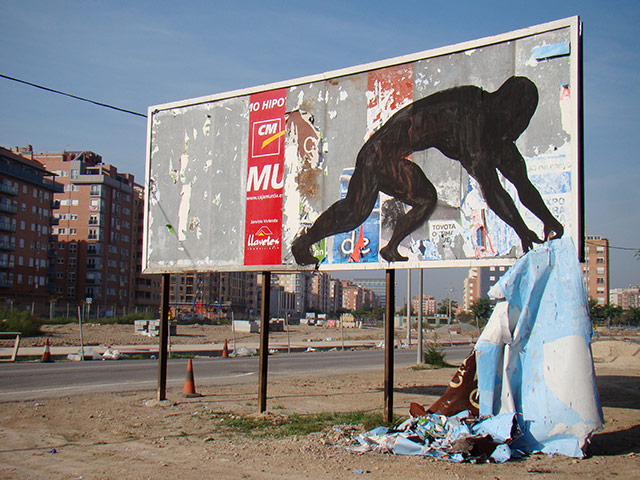
Check out the whole slideshow at http://www.guardian.co.uk/culture/gallery/2011/aug/07/art
Here's a great one from the piece, all of which are fantastic:
Check out the whole slideshow at http://www.guardian.co.uk/culture/gallery/2011/aug/07/art
Jul 31, 2011
In Defense of L.A.'s Mojo

A week or so ago, a blog post by Joel Kotkin was making some waves among economic geographers, urban studies people, etc., for its rather alarming headline proclaiming that "America's Young and Restless Will Abandon the Cities for the Suburbs." While I didn't dispute the actual, less shocking, conclusions of the piece - 'suburbs' are increasingly important job centers and even people who were hip in their 20s may still leave urban cores to raise families in their 30s - like many people I was wary of the article's phrasing, the misinterpretation implied by the headline (that suddenly the hip, creative youth of America were more attracted to white picket fences than to diversity and loft-dwelling), and the ever-worrisome definitional problems surrounding 'suburbs versus city debates' (not just a problem of Professor Kotkin's, though he has been criticized on this count before). Still, I filed it away as an interesting counterpoint to the assumptions of creative class dogma and went on with my life.
But THEN, this weekend, a friend forwarded me Kotkin's latest, and this one struck a cord. The article, an op-ed piece for the Wall Street Journal entitled "How Los Angeles Lost its Mojo," promised another neo-traditionalist, pro-business critique of the too-urban, too-dense progressive urban policies that he views as the wrong fit for Western cities like L.A. Now, I too am a believer that the success of Los Angeles lies in its exceptionalism and dislike the idea that the city should try to copy New York in the form of things like "LA Live", but Kotkin and I are polar opposites when it comes to being fans of walkability, density, transit, etc., so I knew that I would have my differences with some of his policy proscriptions. What surprised me, however, was how openly Kotkin shows his ideological cards here (perhaps it was inspired by the friendly audience of the Journal's editorial pages).
Right up front, sounding for all the world like Harry Chandler, he praises the "pleasant climate and a business-dominated political economy" of the early 20th century -- which was one of the the most vicious and violently anti-union, anti-labor, anti-mexican, and pro-turning-L.A.-into-a-banana-republic periods in American history. He moves on to praise the "pro-business" Riordan/Wilson years, which he ties to L.A.'s economic successes of the late 1990s, before proceeding to smear current-Mayor Villaraigosa for the sorry corporate business climate and other economic troubles of today...
Subscribe to:
Posts (Atom)