Showing posts with label dissent protest resistance. Show all posts

Nov 15, 2011

The Place of Space in Occupy Wall St. Coverage

With the Occupy Wall Street encampment in Zuccotti Park now (at least temporarily) cleared, it's an especially fitting time to finally finish some writing I've been meaning to put up concerning the way that space and place have figured into the protests themselves and their presentation in the media and public dialogue.

Back in February I wrote about the Spatiality of Protest Coverage during the Arab Spring. I would argue that O.W.S. and it's myriad offshoots (not to mention predecessors in Madrid etc.) are no less acutely spatially-focused than the occupation of Tahrir Square. Interestingly, however, I've found that coverage of the movement, once it finally got going, has featured far fewer maps! To be fair, there's a little less to map (e.g. a small plaza in the downtown grid) and the site is less exotic to anglophone readers, but I would still have expected some more nice renderings of the position of Zuccotti Park in relation to Wall St. proper, City Hall, and the WTC site, and to sites of marches and rallies like Union Square and the Brooklyn Bridge.

Instead, we got primarily person-on-the-street camera angles of small numbers of people milling about with signs or playing drums and, especially in the printed press, photos of protestors and police shouting at each other over railings or simply of individuals from a slice of life/human interest perspective (which were great, by the way - especially this one about love and pepper spray).

At the same time though, an important meme in some of the protest coverage concerned the politics and identity of spaces themselves. The symbolism of and conflict over particular sites (St. Paul's, L.A. City Hall), or multiple sites, were discussed more than they might be in other protests (though admittedly in some cases this was simply a factor of the length and physical impact of the protestors' presence). The seemingly-ideal legal circumstances of Zuccotti Park inspired new interest in privately owned public spaces. Even in the clearing of the plaza this morning, Bloomberg directly engaged essential questions of protest, free speech, and Right to the City claims:
"The First Amendment gives every New Yorker the right to speak out – but it does not give anyone the right to sleep in a park or otherwise take it over to the exclusion of others [...] it does not protect the use of tents and sleeping bags to take over a public space."
Finally, in some cases there has been a fantastic and very welcome interest in the character and culture of the sites themselves (and this is more in keeping with some of what we saw about Tahrir Square). From my own perspective the various forms of place-making and informal urbanism at Zuccotti Park were the most exciting things about the place; it's hard not be enchanted by a group of activated citizens focused on speaking out against inequality but putting much of their time and energy into effectively building a small village (with old timey communications) in a public park. This Washington Post article from just last week on the "vibrant brand of urbanism" at DC's McPherson Square was right up my alley:
"...looked at solely as an aesthetic and cultural phenomenon, [the Occupy movement] has deep roots in ideas with established pedigrees in the world of art and architecture. Its anti-consumerist ethos, its impatience with the media and its love of theatrical intervention in city life make it a direct heir of the Situationists, a radical European avant-garde collective begun in the late 1950s with ideas that remain influential today.

"It might also be considered a living exercise in do-it-yourself (or DIY) urbanism, a trendy movement that strives to engage ordinary people in a hands-on approach to shaping and claiming public space."
So, even if there are fewer maps and diagrams in the New York Times, there has been a wonderful turn toward the politics, identities, and cultures of certain spaces (and of spatial protests). That the protests/occupations themselves may not really be able to exist in the same magical form just anywhere does add a level of complexity for organizers in the wake of periodic disbursements and evictions, and a vulnerability that authorities can exploit. One of the many tragedies of today's early morning raid on Zuccotti Park is surely the razing of the library and the trashing of 5,000 books.

Then again, as OWS activists marching against 'stop and frisk' as I write this are reminding the streets of Brownsville, "Ain't no power like the power of the people, 'cause the power of the people don't stop."


update:To wit: http://www.nytimes.com/2011/11/16/nyregion/occupy-wall-street-organizers-consider-value-of-camps.html

Aug 7, 2011

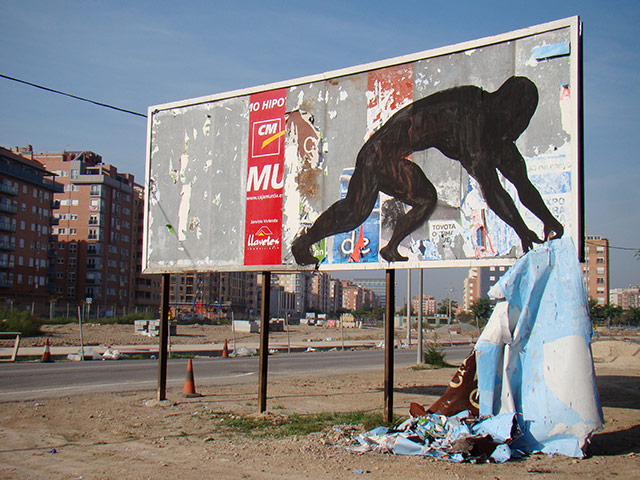
The '10 Best Street Art Works'

Tristan Manco, an English designer and author, presents his '10 best street art works - in pictures' in the Observer online. Manco's books Street Logos and Stencil Graffiti were absolutely inspirational to me the better part of a decade ago when I first became entranced by the global street art phenomenon while living in London (as I recall, I bought Street Logos on one of my first ever trips to Magma).

Here's a great one from the piece, all of which are fantastic:


Check out the whole slideshow at http://www.guardian.co.uk/culture/gallery/2011/aug/07/art

Jul 8, 2011

Slow Puncture - Shoreditch Street Art

Seems about time for another cool music video on a theme close to my heart (see previous entries in this vein here and here)... this a cool tune, great video, and lots of shots of London's lovely, hip Shoreditch neighborhood. Being one of the world's foremost street art meccas, the video features plenty of that:


For more on the artist, She Makes War, and the video and the song and all that, please visit:
http://www.shemakeswar.com/sp.htm

Thanks Oli.

Feb 4, 2011

The Spatiality of Protest... Coverage

One fascinating side-story to come out of the ongoing revolutionary uprising in Egypt has been the spatial emphasis in the media’s coverage. That the protests themselves have been quite essentially spatial (and urban) is unsurprising of course. As Lefebvre, Sassen, and others have long argued, political struggle in the modern era is in many respects fundamentally a struggle over space, with the urban the primary site of expression and contention (see also my post from last year on the link between urban space and "everyday" resistance). What is perhaps more surprising is the degree to which the media – especially, it seems to me, The New York Times online, in addition to Al Jazeera of course – has taken a street-level perspective and embraced the value of spatial data in covering and communicating the news.

From the beginning, right alongside the influential and eye-opening live coverage streaming from Al Jazeera’s website has been an emphasis on mapping the locations of the uprising. The NYT had similar information up almost as immediately. Op-Ed pieces with titles like "The View From Tahrir Square" quickly appeared. Particular spaces became the subject of coverage, such as the Kasr al-Nil Bridge, in the battle for which the Times declared "Egyptian hopes converged."

More recently, as government-organized supporters clashed with opposition demonstrators in the streets, the Times featured this striking graphic:

See also the one used atop this post. Meanwhile a Nicholas Kristoff op-ed piece in today’s paper captured the revolution from the micro-space of a few people in a few tiny corners of the square. And on television it has become quite common even on cable news for the desk anchor of the moment to throw it back “live to Tahrir Square” for an update. Hard to know what to make of this - it is certainly partly explained by the fact that these protests have in fact been largely focused on the particular and iconic space of this square, much like the Berlin Wall and Brandenburg Gate a generation ago. And the sheer amount of information of all types being made available by media outlets is the bigger story overall. But it is fitting that, with "the Arab street" having long been an important concept in political science, international affairs, and even foreign correspondence, the uprising in Cairo has welcomed an especially urban spatial consciousness in the media that now has the technology to visualize it as well.


UPDATE
: one more nice map from the New York Times summing up 18 days of protest: http://www.nytimes.com/interactive/2011/02/12/world/middleeast/0212-egypt-tahrir-18-days-graphic.html?hp

Oct 25, 2010

DIY Urban Design & the Right to the City

I'm going to be presenting a paper as part of a panel on "Rights, Space and Places" at the American Association of Geographers annual conference in Seattle in April. The panel is being organized by James DeFilippis and David Imbroscio. This is the abstract for my paper.


Do-It-Yourself Urban Design

Reimagining the Built Environment through Place-Based, Site-Specific Art and Activism

This paper presents research into practices of place-based, site-specific art and activism that question the normative uses and meanings of urban spaces. Small-scale acts of transgressive “beautification,” such as guerrilla gardening, adbusting, graffiti, yarn-bombing and other street art, assert freedom of expression and control with the built environment as canvass, while the defiant repurposing or misusing of spaces and structures through impromptu street closing, interventionist games, and guerrilla theater temporarily challenge authority and the status quo. In the context of theories of critical spatial practice and everyday resistance (Lefebvre, de Certeau, Scott and others), I argue that these phenomena constitute meaningful expressions of consciousness and critique of the neoliberal city. Rather than formal acts of “resistance” in any strong sense, however, I draw on empirical data from fieldwork in New York, London, and Los Angeles to show that the practices should be seen as individual, informal “right to the city” claims, often in direct response to specific socio-spatial conditions. These practices of place-based, site-specific art and activism suggest a new sense of the city’s “malleability” in some people’s eyes, defined by a willingness to reimagine the built environment on their own terms through a radical sort of ‘do-it-yourself’ urban design.

Oct 5, 2010

On the Value and Censorship of Tweetable Dissent

My pal John Wagner Givens has a great new blog post up on the Huffington Post about online censorship vis-a-vis the digitization of dissent, featuring a pointed critique of the whole concept of condensing radical thought down to 140 characters.
You should read it. And below are some comments I had, and John's response.
Re: Twitterpated: Censoring 140 Characteres

Great post John, great points. I'm glad you didn't just tweet it.

The idea of dissidents being forced (back) into self-publishing is an important one, and speaks to questions of how it's ironically often easier to control things online (and in other manufactured interfaces) than more traditional or analogue expression. That said, it would still seem an unfortunate step backward for a movement to have to abandon (lengthier) electronic communication altogether.

Also, to what degree have Chinese authorities censored that original 140-character instantaneous transmitter of protest, the text message?

Read the Article at HuffingtonPost

Sep 2, 2010

The Theoretical Contexts of Practices of Spatial Contention

This is the abstract for the paper I gave yesterday at the Royal Geographical Society in London. I was part of a session on "Complex Geographies of Post-Crisis Social Movements" organized by Maarten Loopmans and Walter J. Nichols.


Expression, Critique, and Resistance in Localized Practices of Contesting and Reclaiming Urban Space

This study suggests an understanding of contemporary practices of contesting or reclaiming urban space as instances of highly individualized, localized resistance to the commoditization of cityspace under advanced capitalism. Phenomena including so-called guerrilla gardening, adbusting and graffiti, political squatting, and other spatially-attuned activism and expression have received relatively little scholarly attention, yet could benefit from consideration in the context of critical geography and social movements literatures. At the same time, the theories behind these disciplines stand to gain from the empirical analysis of these phenomena.

With their subtle but swiftly growing importance in many cities over the past several decades, practices of spatial reclaiming also present examples of the rapid development and uptake of new repertoires of ‘contentious performance’ (Tilly), while the forms taken by this expression also raise questions of scale and place for contentious politics. This paper considers the meaning of these highly informal, localized, and often quite individual spatial actions for social movement studies as well as critical theory. Through a focused analysis of the relevant literature and research on critical spatial practice, everyday resistance, and the neoliberal city as preeminent site of struggle (including Lefebvre, Harvey, de Certeau, Scott, Goonewardena and others), I offer a theory of reclaiming as an expression of critique and resistance to contemporary urban socio-spatial conditions, as well as the methodological context in which specific instances of these phenomena can be studied and understood.

Aug 26, 2010

On the Link Between Urban Space and "Everyday" Resistance

As I continue my research into the practices of urban spatial “reclaiming” and “intervention” that I’m calling “localized spatial contention,” a sort of ongoing project in much of my thinking has been clarifying the connection between urban space and “resistance.” In general this is obvious enough for anyone with a mind for critical human geography or other spatialized political economy, viewing cityspace as a primary site for the production and consumption of capital and thus a primary site for resistance. Sociologists, political scientists and others have likewise emphasized the easily observable fact that cities – their streets, public spaces, and buildings – are frequent cites of popular struggle. More subtly though, what about the ideas of self-expression and ‘critique’ as amounting to sub-revolutionary forms of resisting alienation and false consciousness that can be found in the writings of Henri Lefebvre, Michel de Certeau, and later cultural theorists?

Lefebvre sees the everyday dialectically, not only the trivial, stultifying, and alienating construct of mass culture but also – thus – as the venue for consciousness and transformation. He writes that transformation of society can only be achieved through transformation of the everyday, because the problem of revolutionary totality “is posed and is resolved on the level of everyday life” (1947 [2008], p 250). Consciousness alone is powerful: “consciousness of alienation – that strange awareness of the strange – liberates us, or begins to liberate us, from alienation” (1957 [2008], p 20). And so Lefebvre saw the practice of critique as itself emancipatory and something we might all engage in (even if he is inconsistent on the possibilities here and their value; see also my previous post on Lefebvre’s theory of “moments”).

The connection with space – and urban space in particular – came along with the rest of Lefebvre’s “spatial turn” that came to define his work in and beyond the 1960s. Lefebvre saw “the urban” as a new era or epoch of society, tied to the dominant mode of production (i.e. from feudal to industrial to urban), a “problematic” through which hegemonic social and economic forms (sometimes described as the far order) can be understood – and contested – in the everyday (the near order). These forms or levels come together as a single arena for Lefebvre’s lifelong critical project, the twin dialectics of the everyday and the urban: everyday life is a realm of alienation and false consciousness, yet it is through engagement with everyday life
that one might transform the everyday, and thus transform social reality; the urban is where the hegemony of ‘far order’ global-level conditions are at their starkest and space is organized most explicitly for state control and the accumulation of capital, yet it is where the far order and the near order come together, and the site of contention.

I
n fact, as Goonewardena (2005, p 67) suggests, Lefebvre’s vision of revolutionary struggle is perhaps most clearly understood in terms of all three levels: a struggle waged against the hegemony of the “global,” using the utopian energies and possibilities inherent in the contradictions of “everyday life,” fought on the terrain of the urban intermediary. This is the link between urban space and everyday resistance.

What’s more, the starkness of the contradictions and the need for this struggle are, arguably, all the more apparent in the contemporary, neoliberal city. In The Urban Revolution (1970 [2003], p 92), Lefebvre offers the following appraisal of the city under advanced capitalism and the need for its transformation as part of the revolutionary project, an appraisal that could serve as a rallying cry for the forms of transgressive or counter-normative localized spatial contention that I’m studying:
“Space becomes increasingly rare—it is expensive, a luxury and privilege maintained and kept up through a practice (the ‘‘center’’) and various strategies. The city does indeed grow richer. […] But it collapses under the weight of its wealth. The more it concentrates the necessities of life, the more unlivable it becomes. The notion that happiness is possible in the city, that life there is more intense, pleasure is enhanced, and leisure time more abundant is mystification and myth. If there is a connection between social relationships and space, between places and human groups, we must, if we are to establish cohesion, radically modify the structure of space.”


Works cited:
Goonewardena, Kanishka. 2005. “The Urban Sensorium: Space, Ideology, and the Aestheticization of Politics,” Antipode, Vol. 37, No. 1. 46-71.
Lefebvre, Henri. 1947 (2008). Critique of Everyday Life Vol. I: Introduction, 2nd Ed., trans. J. Moore. London and New York: Verso.
Lefebvre, Henri. 1957 (2008). “Foreword to the Second Edition” in H. Lefebvre, The Critique of Everyday Life Vol. I: Introduction, 2nd Ed., trans. J. Moore. London and New York: Verso.

Mar 25, 2010

Lefebvre's Theory of Moments

Trying to get to the core of sub-revolutionary but nonetheless valuable forms of "resistance" has become central to my theoretical inquiries recently as I try to work out a context in the literature for understanding the practices of 'spatial contention' (street art, guerrilla gardening, political squatting, other counter-normative 'urban interventions) that I am researching. One of the most fertile thinkers on these ideas is Henri Lefebvre, the French Marxist and critical theorist who is currently enjoying something of a renaissance in anglophone urban studies.

Lefebvre emphasized the value of criticism at the level of the 'everyday' and essential for the revolutionary project and saw the practice of critique as itself emancipatory and something we might all engage in. How exactly this is to be accomplished is another question, however, an ambiguity developed in fits and starts over a long career. I'm working on a more thorough review of these ideas, but one of the most interesting yet at the same time frustratingly elusive concepts is that of the "moment," something that reveals the “breadth and magnificence of the possibilities” inherent in the existential ennui of daily life (1947 [2008], p 229).

Built out of the ideas of Leibniz, Hegel, and Marx (see note below),“moments” are strenuously intangible when variously described by Lefebvre, but the important components can be drawn out. The concept first turns up in a somewhat overly-nostalgic discussion of ancient and peasant cultures that Lefebvre idealizes as having been extant prior to alienation (which was to his mind a sort of historically progressing process tied to modernity, capitalism, and the commodity form). “Mystics and metaphysicians,” he argues, “used to acknowledge that everything in life revolved around exceptional moments… These moments were festivals: festivals of the mind or the heart, public or intimate festivals” (p 250).

Moments are first discussed at length in Lefebvre's 1959 autobiographical work
La Somme et le reste (from which I've recently translated a seemingly-important untranslated chapter), mostly as a concept that he admits he had long struggled to define and finally described unsatisfactorily through examples of what he calls “partial totalities”: love, play, struggle, creative activity (1959 [1989], pp 235, 237).

Two years later, Lefebvre offered a “theory of moments” in which the moment is defined as “the attempt to achieve the total realization of a possibility” (1961 [2008], p 348), and is again exemplified as love and play, and as festival. Lefebvre adds years later that some moments “are seeking to shatter the everydayness trapped in generalized exchange,” and seek to “transform daily life through poetry” (1981 [2008], pp 57, 172). A somewhat clearer summary of the idea is offered by Merrifield (2006, p 29): “Just as alienation reflected an
absence, a dead moment empty of critical content, the Lefebvrian moment signified a presence, a fullness, alive and connected.” While sloppily defined by Lefebvre, the idea of the moment is important to his theory, a shared, imprecise-but-mutually recognizable meme of experience that serves as a potentially liberating exception to the everyday that is nonetheless born of the everyday.

Still, the search for the possible via the festival or the moment are
not ‘revolutionary’ in themselves for Lefebvre. As others have pointed out (Trebitsch, 2002 [2008]; Merrifield, 2006; 2008) the Lefebvrian moment can be seen as somewhat analogous to (and even inspirational of) “the situation” of Guy Debord and the Situationists, yet Lefebvre disputed the idea that simply subverting the everyday will lead to consciousness of ‘real life.’ Lefebvre even seems sometimes unsure of the chances for success even through his own philosophy of praxis, turning away from the emancipatory potential of his quotidien critique at times to a more skeptical tone and language suggesting the unlikelihood of the necessary revolutionary preconditions. The possibilities for clarity and critique (and thus transformation) are always present in Lefebvre’s theory, but his optimism for them is inconsistent. Particularly in his earlier work, they are fleeting, tentative, beyond the reach of most of us most of the time, confined to “certain privileged moments of lucidity” while “most people remain imprisoned within narrow, out-of-date frames of reference” (2008a, p 247).

Furthermore, Lefebvre argues that “Consciousness must be gained over and over again through action and struggle as well as through organizations whose role is to penetrate everyday life” (p 151). Through the critique of everyday life, the individual can learn “certain infinitely delicate but efficacious techniques which will give him active power over himself qua content” (p 248), but “the problem remains: how can the ‘masses’ – whether masses of moments of masses of human beings – ‘participate’ in a total vision” (p 250). Lefebvre thus explains and essentially accommodates for the lack of socialist revolutionary transformation at once, putting the ideal ‘total moment’ on “a distant horizon beyond our present vision” (2008d, p 66) and emphasizing the value of seemingly minor, personal moments whereby the transformation of everyday life might still be slowly affected.


*Note: Merrifield (2006, p 29) succinctly describes the significance of “moments” for Hegel and Marx: “All dialectical movement progressed through different moments: moments of skeptical, negative consciousness defined history for Hegel; moments of contradictory unity defined and structured capitalism for Marx. All reality for both thinkers was momentary, transient, in motion, in fluid state, whether as an idea or as material reality.”


Works cited:
Lefebvre, Henri. 1947 (2008). Critique of Everyday Life Vol. I: Introduction, 2nd Ed., trans. J. Moore. London and New York: Verso.
Lefebvre, Henri. 1957 (2008). “Foreword to the Second Edition” in H. Lefebvre, The Critique of Everyday Life Vol. I: Introduction, 2nd Ed., trans. J. Moore. London and New York: Verso.
Lefebvre, Henri. 1961 (2008). Critique of Everyday Life Vol. II: Foundations for a Sociology of the Everyday, trans. J. Moore. London and New York: Verso.
Lefebvre, Henri. 1981 (2008). Critique of Everyday Life Vol. III: From Modernity to Modernism, trans. G. Elliot. London and New York: Verso.
Merrifield, Andy. 2006. Henri Lefebvre: A Critical Introduction. New York and London: Routledge.
Merrifield, Andy. 2008. “Lefebvre and Debord: A Faustian Fusion,” in K. Goonewardena, et al. eds., Space, Difference, Everyday Life: Reading Henri Lefebvre. New York and London: Routledge.
Trebitsch, Michel. 2002 (2008). “Preface: The Moment of Radical Critique,” in H. Lefebvre, Critique of Everyday Life Vol. II: Foundations for a Sociology of the Everyday, trans. G. Elliot. London and New York: Verso.

Mar 29, 2009

The CTA Gold Line?

Yours truly has been working with a Chicago social justice group called SOUL (Southsiders Organized for Unity and Liberation) on various things pertaining to a "more equitable" olympics, should Chicago win the bid. Many are outright opposed to it, but there's an effort to at least make sure that there are protections for the poor/homeless and long-term advantages for the south side if it DOES have to happen. One of things they're fighting for is the so-called Gold Line (see for example http://bit.ly/fxsEi), basically converting one of the southeast Metra Electric tracks to a regular rapid transit service (run by CTA or Metra, we don't care) with frequent trains, CTA fares and easy transfers, etc. Anyway, I am proud to be responsible for this nifty map at right (click here for larger image: http://home.uchicago.edu/~gdouglas/GoldLineMap.jpg