Dec 20, 2011

Spontaneous Interventions: Venice Architecture Biennale 2012

I'm honored to announce that I'll be working with the Institute for Urban Design and a team of incredible curators on the American representation at the 13th Venice Biennale of Architecture in 2012. Sponsored in part by the Department of State's Bureau of Education and Cultural Affairs, the U.S. pavilion's theme will be "Spontaneous Interventions: Design Actions for the Common Good" - a topic very close to my heart. From the online statement:
"In recent years, there has been a nascent movement of designers acting on their own initiative to solve problematic urban situations, creating new opportunities and amenities for the public. Provisional, improvisational, guerrilla, unsolicited, tactical, temporary, informal, unplanned, participatory, open-source—these are just a few of the words that have been used to describe this growing body of work. Spontaneous Interventions will frame an archive of compelling, actionable strategies, ranging from urban farms to guerilla bike lanes, temporary architecture to poster campaigns, urban navigation apps to crowdsourced city planning. In recent years, there has been a nascent movement of designers acting on their own initiative to solve problematic urban situations, creating new opportunities and amenities for the public. Provisional, improvisational, guerrilla, unsolicited, tactical, temporary, informal, unplanned, participatory, open-source—these are just a few of the words that have been used to describe this growing body of work. Spontaneous Interventions will frame an archive of compelling, actionable strategies, ranging from urban farms to guerilla bike lanes, temporary architecture to poster campaigns, urban navigation apps to crowdsourced city planning."
As a project manager I've been working with Cathy Lang Ho, Mimi Zeiger, and Anne Guiney and Brendan Crain at the Institute on cataloging instances of informal and 'tactical' urban design intervention across the country. In the coming weeks and months we'll be selecting projects to highlight in different ways in Venice and working with designers, artists and curators to realize the pavilion. A full, free-standing webpage with lots more info and an interactive blog platform is coming soon. In the meantime, check out http://www.ifud.org/venice/.

Nov 15, 2011

The Place of Space in Occupy Wall St. Coverage

With the Occupy Wall Street encampment in Zuccotti Park now (at least temporarily) cleared, it's an especially fitting time to finally finish some writing I've been meaning to put up concerning the way that space and place have figured into the protests themselves and their presentation in the media and public dialogue.

Back in February I wrote about the Spatiality of Protest Coverage during the Arab Spring. I would argue that O.W.S. and it's myriad offshoots (not to mention predecessors in Madrid etc.) are no less acutely spatially-focused than the occupation of Tahrir Square. Interestingly, however, I've found that coverage of the movement, once it finally got going, has featured far fewer maps! To be fair, there's a little less to map (e.g. a small plaza in the downtown grid) and the site is less exotic to anglophone readers, but I would still have expected some more nice renderings of the position of Zuccotti Park in relation to Wall St. proper, City Hall, and the WTC site, and to sites of marches and rallies like Union Square and the Brooklyn Bridge.

Instead, we got primarily person-on-the-street camera angles of small numbers of people milling about with signs or playing drums and, especially in the printed press, photos of protestors and police shouting at each other over railings or simply of individuals from a slice of life/human interest perspective (which were great, by the way - especially this one about love and pepper spray).

At the same time though, an important meme in some of the protest coverage concerned the politics and identity of spaces themselves. The symbolism of and conflict over particular sites (St. Paul's, L.A. City Hall), or multiple sites, were discussed more than they might be in other protests (though admittedly in some cases this was simply a factor of the length and physical impact of the protestors' presence). The seemingly-ideal legal circumstances of Zuccotti Park inspired new interest in privately owned public spaces. Even in the clearing of the plaza this morning, Bloomberg directly engaged essential questions of protest, free speech, and Right to the City claims:
"The First Amendment gives every New Yorker the right to speak out – but it does not give anyone the right to sleep in a park or otherwise take it over to the exclusion of others [...] it does not protect the use of tents and sleeping bags to take over a public space."
Finally, in some cases there has been a fantastic and very welcome interest in the character and culture of the sites themselves (and this is more in keeping with some of what we saw about Tahrir Square). From my own perspective the various forms of place-making and informal urbanism at Zuccotti Park were the most exciting things about the place; it's hard not be enchanted by a group of activated citizens focused on speaking out against inequality but putting much of their time and energy into effectively building a small village (with old timey communications) in a public park. This Washington Post article from just last week on the "vibrant brand of urbanism" at DC's McPherson Square was right up my alley:
"...looked at solely as an aesthetic and cultural phenomenon, [the Occupy movement] has deep roots in ideas with established pedigrees in the world of art and architecture. Its anti-consumerist ethos, its impatience with the media and its love of theatrical intervention in city life make it a direct heir of the Situationists, a radical European avant-garde collective begun in the late 1950s with ideas that remain influential today.

"It might also be considered a living exercise in do-it-yourself (or DIY) urbanism, a trendy movement that strives to engage ordinary people in a hands-on approach to shaping and claiming public space."
So, even if there are fewer maps and diagrams in the New York Times, there has been a wonderful turn toward the politics, identities, and cultures of certain spaces (and of spatial protests). That the protests/occupations themselves may not really be able to exist in the same magical form just anywhere does add a level of complexity for organizers in the wake of periodic disbursements and evictions, and a vulnerability that authorities can exploit. One of the many tragedies of today's early morning raid on Zuccotti Park is surely the razing of the library and the trashing of 5,000 books.

Then again, as OWS activists marching against 'stop and frisk' as I write this are reminding the streets of Brownsville, "Ain't no power like the power of the people, 'cause the power of the people don't stop."


update:To wit: http://www.nytimes.com/2011/11/16/nyregion/occupy-wall-street-organizers-consider-value-of-camps.html

Nov 11, 2011

Forthcoming Article on Local Culture and Urban Development

My article on the impact of local cultural expectations on the process and politics of urban development is on its way to publication in Sociological Perspectives early this year. I'm so glad to have a final green light from the editors and to see this project - which began as a term paper in my first year of graduate school, then evolved into my MA 'qualifying paper' and my first ASA presentation - finally on its way to the (still relatively obscure) light of day in a generalist peer-reviewed sociology journal.

The article, "Cultural Expectations and Urban Development: The Role of 'Cultural Sensitivity' and 'Cultural Sincerity' in Local Growth Politics", features a case study of two recent development proposals in Davis, California. In particular, I argue that the Target Corporation's attention to local expectations of unique small-town charm and leadership in environmental sustainability paid an important role in their ability to win voter approval for a (first) 'big box' store in this vocally 'anti-corporate' community. By contrasting this victory with a failure the previous year of an ostensibly local and green housing development, I show how both cultural sensitivity and sincerity can be instrumental to success.

Nov 9, 2011

Street Art & Magical Urbanism in Japanese Cities


A wonderful article by a_small_lab's Chris Berthelson in This Big City last month got me thinking again about a subject that's long been dear to me - informal urbanism in Japanese cities!

Chris's piece, "The Non-Intentional Landscape of Tokyo," argues that part of the magic of that city is not only its relative geographical centerless-ness, but an essentially "decentralized" way of growing, managing, inhabiting, and relating to itself. Complex redefinitions of public and private space are better understood as interconnected constellations of "scattered uchi." As he writes, "Once thus comprehended, Tokyo’s non-intentional landscape has the appearance of purposefulness in a system which is not purposefully constructed simply because purposeless is in its very nature transitory."

Well this post of mine is not really a response to this lovely bit of urban critical thought, but simply a fun reaction to it - it seems a good enough excuse to put up a few images from my last trip to Japan.

On the left, some sort of book exchange sponsored by Tokyo Metro; right, a classic example of pot gardening in public space in Kyoto. Below, graffiti along the canal in the Nakameguro area. Click for larger images.


Oct 9, 2011

Place-Making at Occupy Wall Street


I was down at Occupy Wall Street a few days last week, hanging out in Zuccotti Park, speaking with people camped out and working there. It's true that they're mostly a somewhat disorganized group camped out in a concrete plaza for a variety of reasons (crust punks, politicians, long-time activists, laid off Wall St. types, union members, long-term homeless) but the media has it wrong that they don't know what they stand for or that they aren't committed to it.


I especially enjoyed checking out many of the DIY amenities that have been created there, from free food and clothing to a massive library, grey water recycling system, technology center, and even a barber! A few images...


Oct 5, 2011

Video Interlude: Detroit Dirt

Just watched a great little video short on urban agriculture in Detroit, from the web series "Perennial Plate." Check it out:


The Perennial Plate Episode 73: Detroit Dirt from Daniel Klein on Vimeo.
Detroit is an amazing place. It's funny too how quickly the possibility of all of this creativity and dynamism (and even 'hipness'!) went from being basically unthinkable there to now being *almost* cliche in some circles (if still, of course, an amazing and only-just-beginning work in progress)!


thanks Justin

Aug 20, 2011

DIY Urban Design at ASA - Las Vegas

I'll be presenting my research on do-it-yourself urban design tomorrow morning at the American Sociological Association's annual conference here in Las Vegas. I'll be joining a panel of fascinating-sounding papers in the regular session on Popular Culture, organized by Dr. Terry McDonnell with Dr. Dustin Kidd presiding. Below is a revised abstract for the paper , the circulation version of which can be found here (pdf).


Do-It-Yourself Urban Design

Making Local Improvements Through Unauthorized Alterations of Urban Space
There are numerous ways in which people make illegal or unauthorized alterations to urban space, its uses, or meanings. This paper presents a particular type of unauthorized intervention, which I distinguish from other “traditional” forms of illegal spatial intervention (graffiti, political occupation, etc.), and which has not been described in previous research: creative, highly localized, and largely anonymous practices that are aimed explicitly at “improving” the built environment of local communities – in other words, “do-it-yourself” urban design. In painting their own crosswalks and bicycle lanes, building and installing benches and other street furniture, or creating faux-official signage to promote desired civic improvements or commemorate unheralded events, people are responding to perceived inadequacies in their communities and taking design responsibilities into their own hands; even small-scale acts of aesthetic alteration assert a vision of the city as open to individual “beautification.” Building from qualitative fieldwork and interviews with individuals in London, Los Angeles, New York, Pittsburgh, Toronto, and Vancouver, I discuss the implications of these practices for understanding the contemporary city and contentious politics and raise questions of rights, responsibilities and perhaps unintended consequences.

Aug 17, 2011

Aspirational DIY Urbanism in Phoenix

Came across this wall on N. 4th St. in Downtown Phoenix today. Had been to the area before on previous visits (it's right near the Roosevelt Row arts district) but this was new to me.

(click to read sign in bigger image)

I wound up meeting the woman behind the project and "Rogue Green" just a couple blocks away in a cafe on 5th, seems it's been a great success. You can learn more about the project at http://roguegreen.blogspot.com/

Here's Brian having a go at it:

Aug 7, 2011

The '10 Best Street Art Works'

Tristan Manco, an English designer and author, presents his '10 best street art works - in pictures' in the Observer online. Manco's books Street Logos and Stencil Graffiti were absolutely inspirational to me the better part of a decade ago when I first became entranced by the global street art phenomenon while living in London (as I recall, I bought Street Logos on one of my first ever trips to Magma).

Here's a great one from the piece, all of which are fantastic:


Check out the whole slideshow at http://www.guardian.co.uk/culture/gallery/2011/aug/07/art

Jul 31, 2011

In Defense of L.A.'s Mojo


A week or so ago, a blog post by Joel Kotkin was making some waves among economic geographers, urban studies people, etc., for its rather alarming headline proclaiming that "America's Young and Restless Will Abandon the Cities for the Suburbs." While I didn't dispute the actual, less shocking, conclusions of the piece - 'suburbs' are increasingly important job centers and even people who were hip in their 20s may still leave urban cores to raise families in their 30s - like many people I was wary of the article's phrasing, the misinterpretation implied by the headline (that suddenly the hip, creative youth of America were more attracted to white picket fences than to diversity and loft-dwelling), and the ever-worrisome definitional problems surrounding 'suburbs versus city debates' (not just a problem of Professor Kotkin's, though he has been criticized on this count before). Still, I filed it away as an interesting counterpoint to the assumptions of creative class dogma and went on with my life.

But THEN, this weekend, a friend forwarded me Kotkin's latest, and this one struck a cord. The article, an op-ed piece for the Wall Street Journal entitled "How Los Angeles Lost its Mojo," promised another neo-traditionalist, pro-business critique of the too-urban, too-dense progressive urban policies that he views as the wrong fit for Western cities like L.A. Now, I too am a believer that the success of Los Angeles lies in its exceptionalism and dislike the idea that the city should try to copy New York in the form of things like "LA Live", but Kotkin and I are polar opposites when it comes to being fans of walkability, density, transit, etc., so I knew that I would have my differences with some of his policy proscriptions. What surprised me, however, was how openly Kotkin shows his ideological cards here (perhaps it was inspired by the friendly audience of the Journal's editorial pages).

Right up front, sounding for all the world like Harry Chandler, he praises the "pleasant climate and a business-dominated political economy" of the early 20th century -- which was one of the the most vicious and violently anti-union, anti-labor, anti-mexican, and pro-turning-L.A.-into-a-banana-republic periods in American history. He moves on to praise the "pro-business" Riordan/Wilson years, which he ties to L.A.'s economic successes of the late 1990s, before proceeding to smear current-Mayor Villaraigosa for the sorry corporate business climate and other economic troubles of today...

Jul 13, 2011

Touring Toronto with the Urban Repair Squad


I was up in Toronto last month for the Experience the Creative Economy conference at the UofT's Martin Prosperity Institute (see earlier post). While I was in town I had the honor and privilege of taking an impromptu guided tour of D.I.Y. urbanism in the city with a spokesperson for the acclaimed local bike lane champions and all-around unauthorized do-gooders The Urban Repair Squad.

Anti-bike signs on the TTC were replaced with a more bike-friendly message (above), and even some classic pieces, like these bike-lane commentaries and "pothole onomatopoeia" are a bit worn down but still doing their part.


As my URS liaison explained, "the group kind of fulfills an official function [...] Above all it asks questions about how urban design is used, and what it is used for."

We also saw some fantastic street art:

Above, Posterchild stencil and others. Below, a piece by Poser (is it?) in Kensington Market, and a slightly disregarded Banksy in an alley. (Click for larger images)

Jul 8, 2011

Slow Puncture - Shoreditch Street Art

Seems about time for another cool music video on a theme close to my heart (see previous entries in this vein here and here)... this a cool tune, great video, and lots of shots of London's lovely, hip Shoreditch neighborhood. Being one of the world's foremost street art meccas, the video features plenty of that:


For more on the artist, She Makes War, and the video and the song and all that, please visit:
http://www.shemakeswar.com/sp.htm

Thanks Oli.

Jun 5, 2011

DIY Urban Design and the Creative Economy

I'm honored to have been selected to participate in the Experience the Creative Economy conference at the University of Toronto's Martin Prosperity Institute, June 21st-23rd. I'll be speaking about my research on DIY urban design and what it may have to tell us about spatial rights and responsibilities in the so-called 'Creative City', and taking part in three days of collaborating and workshopping around issues pertaining to creativity and economic development. Here's the abstract for my paper:


Do-It-Yourself Urban Design
'Improving' the City Through Unauthorized, Creative Contributions

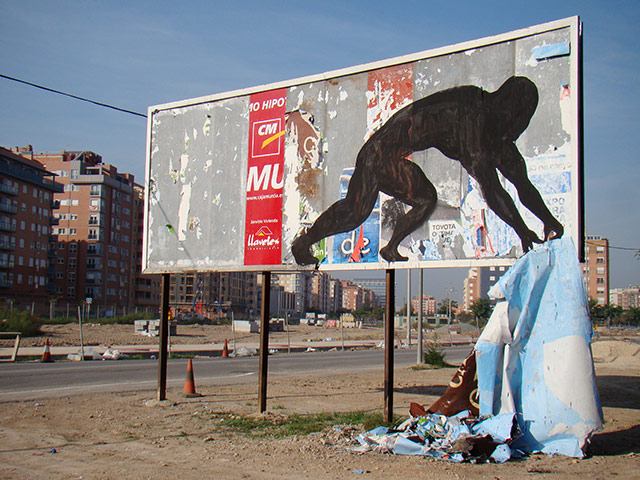
There are numerous ways in which people make illegal or unauthorized alterations to urban space, its uses, or meanings. This paper presents research into a particular type of unauthorized intervention: the creative, highly localized, and largely anonymous practices that are aimed explicitly at “improving” particular aspects of the built environment. In other words, informal “do-it-yourself” urban design contributions. In painting their own crosswalks and bicycle lanes, building and installing much-needed benches and other street furniture, or creating faux-official signage to promote needed civic improvements or commemorate unheralded events, people respond to perceived inadequacies in their communities and take design responsibilities into their own hands; even small-scale acts of aesthetic alteration, such as guerrilla gardening, billboard liberation, and yarn-bombing, assert a vision of the city as popular space open to creative, individual “beautification.” Building on twelve months of qualitative fieldwork and interviews with 40 individuals in six cities (London, Los Angeles, New York, Pittsburgh, Toronto, and Vancouver), I distinguish these practices from “traditional” forms of illegal spatial intervention and discuss their implications for understanding our relationship to the contemporary city. We do not normally think of the urban built environment as something we can reshape at our whim; its uses and meanings are normatively – and often legally – defined and regulated, essentially altered only by professionals. That an increasing number of individuals treat the built environment as open to personal reinterpretation raises a number of questions concerning rights, responsibilities and popular expectations as well as wider and perhaps unintended consequences.

May 3, 2011

DIY Urban Design Piece on GOOD.is

[Updated]

Happy to report that a brand new piece of mine is now up on GOOD! It's sort of a glorified slideshow of various instances of DIY urbanism (taken by both myself and others) and featuring short descriptions and quotes from my ongoing research. The piece is out just in time for the presentation I'm giving on this work at the annual meeting of the Assoc. of American Geographers.

Click the screenshot to visit the article on GOOD.is:

Please check it out!


UPDATE: I'm happy to say the piece has received a ton of great attention, including a nice summary on Planetizen that I'm particularly proud of, as well as other blogs and heaps of tweets from such esteemed urban design commentators as Allison Arieff and Richard Florida. Thanks everyone for taking a look!

May 2, 2011

The bin Laden Raid and Web Hyperinteractivity...

I realize not everyone is as impressed with or interested in the crazy extent to which social media and web interactivity now respond to breaking news like some sort of super dynamic and fast-moving biosystem, but this morning I've just been fascinated by a number of examples of it this as relating to the bin Laden raid. So, some musings:

First, this Pakistani guy (@ReallyVirtual) basically live-tweeted the entire raid as it happened, without knowing what it was, from somewhere nearby enough to hear it go down - and became an almost instantaneous celebrity. This is a compilation somebody made of his "coverage": http://chirpstory.com/li/1288 (or just check out his actual twitter feed: http://twitter.com/#!/ReallyVirtual ) After tweeting for like 16 hours straight (beginning at 1am his time!) and fielding sudden massive requests for interviews and such, his last tweet a few hours ago was "Bin Laden is dead. I didn't kill him. Please let me sleep now."

Apr 7, 2011

Corporate Transit Branding Raises Concerns About Neighborhood Identity


In light of my research on the link between mass transit identification design and neighborhood identity, I was immediately struck by the news coming out of Toronto last week that the TTC is contemplating selling station and subway line naming rights to the highest corporate bidder. This isn't the first time such proposals have been floated by cash-strapped transportation agencies, but if the possibility is to be taken seriously, we should consider its less tangible potential consequences for the communities it may effect.

My research has shown that the identification of transit lines and stations can be a highly sensitive issue in cities, and that these seemingly innocent naming and design decisions can potentially have an important impact on local identity (click for pdf). For instance, not only have drawn out debates demonstrated passionate differences in opinion about how a light rail line's name and color ought to reflect the character of the communities it serves (as has been the case in Los Angeles), but evidence suggests that choosing neighborhood- or landmark-based names for rail stations can to promote (as in Chicago) or even outright define (as in London) community identity, both locally and throughout the system.

So beyond the awesome mock-ups of some new Toronto station signage and a gorgeous system map that the folks at Torontoist created, there may be wider implications of corporate sponsorship on this scale, especially when it concerns things as tied to local culture and identity as transit stations. Would we sell naming rights to our city parks, branch libraries, post offices, or schools?


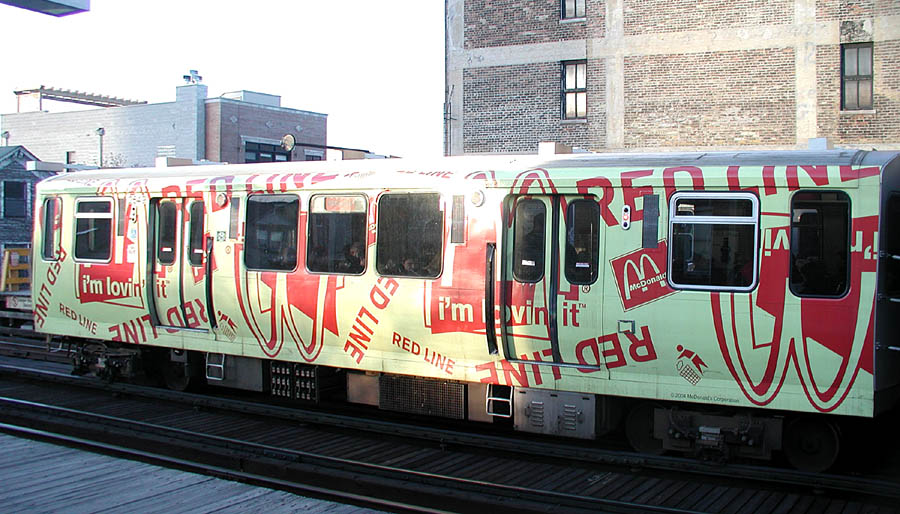
Of course, we cannot pretend such sponsorship doesn't provide serious financial benefits to cash-strapped localities. There are no doubt plenty of riders who would gladly change the name of their local station (maybe even the name of their neighborhood!) in exchange for better transit service. Subway systems are already rife with advertising, and transit agencies should, I think, take advantage of the eyeballs to help subsidize the system. (To that end, kudos to the TTC at least for considering ending their contract with CBS Outdoor and maybe taking a proactive stance on collecting these advertising dollars directly.) Though even here, Jordan Seiler of the Public Ad Campaign has some thoughts on the extremes at which excessive efforts to convert trains and stations into billboards can be too much.

It's a delicate tradeoff, but at the very least the debate about full-scale corporate branding of transit stations and lines should be informed by an awareness of its potential implications for neighborhood identity, and in turn the real importance of this identity for urban communities.

Mar 5, 2011

"DIY Urban Design" Headed to ASA

A paper presenting the results of my dissertation research pilot study has been accepted for presentation at the American Sociological Association's annual conference in Las Vegas this August. I'll be in the regular session on Popular Culture, organized by Dr. Terry McDonnell. This is an abstract for the paper.


Do-It-Yourself Urban Design

Making Local Improvements Through Unauthorized Alterations of Urban Space

All manner of unauthorized alterations and occupations of the built environment can be seen in the city, from juvenile bathroom graffiti to organized political demonstrations. Indeed, practices like graffiti and street art, guerrilla gardening, and the unauthorized use of particular spaces for unconventional purposes have become relatively common features of urban life in recent decades. Limited existing social science research on these alterations (which I collect for shorthand as "spatial interventions") tends to group these practices into one of two basic categories: as strategies of radical political protest and even "resistance," or as little more than concept art, self-promotion, juvenile acting out, or criminal vandalism. Yet in new research I have found many cases that do not fit comfortably with either perspective. These practices are better described (and thus distinguished) by a third logic: intentional but small-scale, ground up, creative "improvements" to particular spaces. This paper briefly reviews the existing literature to draw out its core assumptions, and then presents the findings from a six month study of spatial intervention practices in New York, Los Angeles, and London that suggests an alternative understanding of unauthorized alterations as D.I.Y. urban design contributions.

Feb 14, 2011

The Faux-Tuscan-ization of Downtown Los Angeles


The recent approval of Geoffrey H. Palmer's "Lorenzo" development, at 23rd and Flower just south of Downtown L.A., will see the the Italophile real-estate tycoon's empire of apartment complexes grow to a total of 9 in the area. With nearly identical cheesy aesthetics to match their Tuscan-inspired names, I got to wondering whether we were actually starting to hit a point where they make up a large enough proportion of new residential properties in and around the financial district that the Palmer aesthetic is a noticeable aesthetic for the whole area!

I threw this together in Google maps (click for link to interactive map):


Of course, there are far more Downtown residential properties of both the converted historic bank building variety (seen throughout the Historic Core) and the new-build-loft glass and steel variety (as has come to define the South Park neighborhood). But Palmer's properties are arguably doing something similar in the north and west periphery of the financial district - especially as viewed from the 110 Freeway! Add to this some other similarly-styled developments like the ultra-cheesy "City Lights" complex opposite the Convention Center and a number of new buildings near USC (including the so-identical-and-aptly-named-I-assumed-it-was-Palmer "Tuscana") and you really have a theme going.

I've long had a sort of love-hate relationship with Palmer's buildings, ever since the "Medici" went up with great fanfare around 2000-2002 while I was living nearby, and soon became resort-style home to a many of my fellow USC students. On the one hand, Palmer was arguably pretty important in promoting the residential resurgence in Downtown L.A. - which has on measure been a good thing for the city. And certainly relatively dense apartment buildings are better than the surface parking lots most of his projects have replaced. But Palmer has been a less than caring community member, long dragging his heals about including low-income units, and the buildings themselves are lousy neighbors for their immediate surroundings, the largely lower-income streets north and west of the financial district where they have been plopped down (see this 2004 Downtown News piece for more on Palmer's controversial past.) And regardless of how one feels about the luxurious grounds and interiors or the cheesy Italianate design, many are fortress-like at street level, closed in on themselves and primarily accessible through their underground parking garages.


Even Lorenzo, despite concessions to community demands made to win approval and explicit claims of a transit- and pedestrian-oriented design - all certainly good signs - may still be headed for disappointment in this regard. (See this thorough, if now somewhat outdated, Streetsblog LA dissection of the project's T.O.D. potential). At best I suppose we can hope for something not unlike USC's Tuscana, somewhat oriented toward the street, with (unfortunately bland corporate) commercial use below the apartments. Aesthetically, probably no hope. At least Tuscana matches the Italianate explosion that is the rest of USC's central campus. Another hanging garden-inspired tropical Tuscan paradise at Lorenzo on 23rd Street will really be odd.

Feb 12, 2011

DIY Urban Design at the L.A. Eco Village


Among the first instances of do-it-yourself urbanism that I became aware of a few years ago were the projects of the Los Angeles Eco Village, and learning about them was a big influence on my decision to pursue my research on these and similar activities in cities around the world.

I was fortunate to go back again this week to meet with Joe Linton and other residents of this cooperative living 'intentional community,' near Vermont and Beverly in central Los Angeles. Over the years they have reclaimed their intersection with street art (à la Mark Lakeman and Portland City Repair), painted their own crosswalks, and placed seating and trees in a beautiful bulb-out to calm traffic on the street. They've also been known to calm traffic a little more actively, by closing their street with street parties and family dinners. Here are some more recent pics:


Feb 4, 2011

The Spatiality of Protest... Coverage

One fascinating side-story to come out of the ongoing revolutionary uprising in Egypt has been the spatial emphasis in the media’s coverage. That the protests themselves have been quite essentially spatial (and urban) is unsurprising of course. As Lefebvre, Sassen, and others have long argued, political struggle in the modern era is in many respects fundamentally a struggle over space, with the urban the primary site of expression and contention (see also my post from last year on the link between urban space and "everyday" resistance). What is perhaps more surprising is the degree to which the media – especially, it seems to me, The New York Times online, in addition to Al Jazeera of course – has taken a street-level perspective and embraced the value of spatial data in covering and communicating the news.

From the beginning, right alongside the influential and eye-opening live coverage streaming from Al Jazeera’s website has been an emphasis on mapping the locations of the uprising. The NYT had similar information up almost as immediately. Op-Ed pieces with titles like "The View From Tahrir Square" quickly appeared. Particular spaces became the subject of coverage, such as the Kasr al-Nil Bridge, in the battle for which the Times declared "Egyptian hopes converged."

More recently, as government-organized supporters clashed with opposition demonstrators in the streets, the Times featured this striking graphic:

See also the one used atop this post. Meanwhile a Nicholas Kristoff op-ed piece in today’s paper captured the revolution from the micro-space of a few people in a few tiny corners of the square. And on television it has become quite common even on cable news for the desk anchor of the moment to throw it back “live to Tahrir Square” for an update. Hard to know what to make of this - it is certainly partly explained by the fact that these protests have in fact been largely focused on the particular and iconic space of this square, much like the Berlin Wall and Brandenburg Gate a generation ago. And the sheer amount of information of all types being made available by media outlets is the bigger story overall. But it is fitting that, with "the Arab street" having long been an important concept in political science, international affairs, and even foreign correspondence, the uprising in Cairo has welcomed an especially urban spatial consciousness in the media that now has the technology to visualize it as well.


UPDATE
: one more nice map from the New York Times summing up 18 days of protest: http://www.nytimes.com/interactive/2011/02/12/world/middleeast/0212-egypt-tahrir-18-days-graphic.html?hp

Jan 23, 2011

Looking to Journalism for Inspiration in Quality Cultural Analysis

I just finished reading Chrystia Freeland's remarkable study of "the new global elite" in Atlantic. And I use the word study intentionally - this is among the best new and academically-relevant writing on 'elites' in years, even the more recently well-trodden ground of cosmopolitanism (Hannerz) and the transnational capitalist class (Sassen, Sklair). Freeland confirms the tenets of these concepts through colorful, quote-filled mini-biographies like that of self-described "global nomad" Mohamed El-Erian - raised between Egypt, France, the US, the UK, and Switzerland, Oxbridge educated, now CEO of German-owned but US-based bond manager Pimco, and currently living in Laguna Beach while spending his weeks shuttling between major global cities. Of course, rigorous social science research, with its empirical falsifiability, corroborating statistics, and powerful theoretical connections, is indispensable. But not necessarily any more so than the insights provided by Freeland's sweeping, interview-driven narrative. Her broader conclusions, especially regarding the increasing importance of "intra-emerging-market" collaboration and trade, and the extent of plutocratic antipathy for the American middle class, are certainly important.

Freeland presents this not only clearly, but compellingly - and not only in the sense that one is compelled to agree with her 'findings,' but that one is actually compelled to continue reading! I mean I'm not even all that interested in the subject matter (rich people) or the premise (these rich people are especially and differently rich, a class unto themselves), but I just read it because it was the cover story and now here I've jumped up to blog about it immediately upon finishing it. God forbid a bit of cultural analysis also be a page turner! And the stuff of the business pages no less!

As for the research itself, if the single greatest challenge to the study of elites is famously "access," it is no obstacle for Freeland. She has it and risks it in spades. As global editor-at-large for Reuters, and previously an editor at the Financial Times, Freeland has clearly made valuable and seemingly close connections to the super rich. Sure, the scope (and arguably the interpretation) is limited by this, but I don't think that's the point. Famous and unknown alike, Freeland has intimate quotes from them, and some of most revealing tidbits even come from a few unnamed "wives" of the new elite (does this not make them the new elite too? Freeland does not discuss familial gender equity; perhaps it will be in the forthcoming book). Her reporting from such a personal level might, it seems, risk her standing in this society (for instance she professionally attends and participates in the very elite conferences she writes about), let alone future access to these individuals. But then, perhaps that is another trait of the new elite: they quite like being talked about by global news editors in magazines like Atlantic.

Of course, this particular magazine and a few others have long been homes to brilliant reporting that walks the line between academic scholarship and popular exposé. Atlantic published Wilson and Kelling's controversial and highly-cited initial treatise on "broken windows" theory back in 1982.

Articles of this quality should be both inspiring and perhaps envy-inducing for the more journalistically-inclined social scientists like myself. The connection may be especially applicable to the study of culture. Not only does it lend itself to a somewhat "journalistic" (if I may reclaim that unhelpfully sullied word) approach to research, but its potential popular audience invites a more accessible presentation as well.

I don't want to belabor the point. Certainly there are important and necessary distinctions between "the press" and the academy, in both directions. But Freeland's piece serves as another reminder that while journalism should aim to be as informed as good science, more science should also aim to be as informing as good journalism.