Showing posts with label neighborhood identity. Show all posts

Dec 6, 2012

Starbucks Really Wants to Feel Local and Loved

In an article published earlier this year, I discussed the ways in which even large corporations with seemingly deeply codified "cultures of production" will adapt them in attempts to be sensitive to local character and cultural expectations. Inherent to this "cultural sensitivity" is the ability to act less like a big, generic, outside interloper and more like a distinct commodity aware of local sensibilities. My study was focused on efforts by Target Corp. to win support for a big box store in Davis, California (and another favorite example of mine is Duane Reade's addition of a craft beer bar and growler store to appease opponents of their Williamsburg store), but one of the other examples I listed was Starbucks.

In 2009, the company began rebranding and renaming certain coffee shops in an effort to appear more "local" and less like the gargantuan multinational chain that they are. Though they don't exactly hide that they are more or less just another Starbucks once you're inside, these "Street Level Coffee and Tea" locations have names like "15th Ave Coffee & Tea" or "Roy Street Coffee & Tea," feature unique and atmospheric interior design, and do neat stuff like host local events and offer some different food and drink items (including booze!). There's a great New York Times article about it here.

(image from AFP-Getty, via the New York Times)


Some might wonder why a giant, successful company like that would deliberately upend standard operating procedures, give their own brand identity a backseat, or generally do something that they don't really have to do.  The answer, of course, is that someone there thinks it will quiet a few anti-corporate opponents, win them a few brownie points, and, of course, make them more money (my study, and, for instance, the profit margins at Davis' first Target store, suggest that someone is right). Indeed, Starbucks makes no secret of it's "Street Level Coffee and Tea" innovation, proudly announcing it at the time and continuing to make the affiliation clear on the 'independent' shops website.

Well, today, Starbucks announced yet another interesting move that seems aimed quite simply at assuaging local concerns about the neighborliness of this anything-but-local corporation. But this time it's on a grand scale: the company has just offered to pay more taxes than they are required to in Britain. Apparently, "having listened to customers and the British public," (that's the Times again, quoting a Starbucks press release), they are going to "refrain from claiming certain tax deductions" and "pay taxes over the next two years even if it does not post a profit" (that's just the Times). Now to be fair, this comes after informal allegations of tax dodging in the country. But the point is that they are once again eagerly trumpeting their willingness to make unrequested, costly moves that seem to acknowledge remarkably transparently that they know they're a big multinational behemoth who people don't like, but really still want you to like them.

It's an interesting tactic. It doesn't make me any less wary of their predatory real-estate practices and other inevitable complaints (or any more likely to drink their coffee), but I suppose it's a good thing. It's also, more cynically, the face of a smiley and totally unshakeable capitalism, quietly adapting and easing tension as it keeps bringing in the bucks.

Nov 28, 2012

"The Edge of the Island: Cultural Ideology and Neighbourhood Identity at the Gentrification Frontier"

I'm happy to report that my article on the geography of "fringe" or "first-wave" gentrification has been published in Urban Studies. As I've noted before, the ethnographic study focuses on the attitudes of newcomers to a part of Chicago's West Town community area that has long lacked for clear identity. It discusses the motivations these individuals have for seeking out the "edge of the island," a romanticized cultural space that is just far enough from established trendy areas. The article is in the December issue, vol. 49, no. 16, and available online here. The abstract follows.


The Edge of the Island
Cultural Ideology and Neighborhood Identity at the Gentrification Frontier
Building on recent ethnographic accounts that have drawn attention to the nuanced ideologies of contemporary gentrifiers, this article brings cultural considerations to bear on the geography of gentrification's fringes. Through a case study of a neighborhood at the gentrification frontier in Chicago, it examines the factors driving first-wave 'pioneers' into an area with little prior popular identity or interest. Conscious of the wider gentrification process, these individuals are essentially seeking (and creating) a particular time and place within it - they idealize the 'edge' itself. Yet while they are actively fleeing advanced gentrification, their actions pave the way for its further expansion. The study finds that gentrification's borders are subjective and relative in the minds of newcomers themselves, who frame the process in terms of their own ideologies. These sub-cultural ideals are central to understanding the expansion of the gentrification frontier today. 

Aug 9, 2012

"The Self-Conscious Gentrifier"

My friend and colleague Naomi Bartz and I are looking forward to presenting our co-authored study on the self-awareness and conflicted actions of first-wave gentrifiers at the American Sociological Association annual conference in Denver this month.  I'll be giving the talk for us both, on Sunday morning in the Colorado Convention Center. The session is being organized by Amin Ghaziani (UBC) and Leonard Nevarez (Vassar).  Below is the abstract for the paper.


The Self-Conscious Gentrifier

The Paradox of Authenticity and Impact Among 'First-Wave Neo-Bohemians' in Two Changing Neighborhoods
Gentrification has been a major factor reshaping North American cities for at least four decades, as well as a vital concern of sociological research. In recent years, there appears to be an increasing awareness of the process among contemporary gentrifiers themselves. This self-conscoiusness is significant on two levels: (1) it is unanticipated by or at least unaccounted for in much of the canonical literature on gentrification, having only recently gained acknowledgement (most notably work by Brown-Saracino that explores aspects of a particular type of self-aware gentrifiiers); (2) it is complicating the way many gentrifiers or would-be gentrifiers frame and actively work toward their ideals of neighborhood, community, and place. Responding to existing literature and recent critiques, we combine findings from our own ethnographic research on first-wave “neo-bohemian” newcomers in distinct contexts of early-stage gentrification in Chicago and Vancouver. We demonstrate the degree to which these individuals, possessing shared ideals for lifestyle and community and a romanticization of “authentic” and “edgy” urban places, exhibit a sophisticated understanding of the process and complicated attitudes towards their own responsibility for neighborhood change.  By focusing on first-wave gentrifiers in rapidly changing neighborhoods - overlooked in Brown-Saracino's work and other recent studies - we address the degree to which these individuals reconcile (or do not) their self-consciousness around their own gentrifier status. Making use of our findings in the two different sites, we also demonstrate the importance of context, by arguing that this activity is shaped both by shared cultural values and specific environmental contexts.

Jul 25, 2012

Place-Making with James Rojas... in New York!

From East L.A. to the East Village, urbanist and planner James Rojas is in NYC this month for engagements at Pratt and elsewhere. He's also been taking his Place-It! workshops all around the city! Last night I was able to attend one myself, held in Tompkins Square Park as part of the Urban SPACEship meet-up group.

The event was great, with dozens of people assembled on the grass in Tompkins Square. James explained his method, to inspire everyday community members to think about their placemaking ideals without the restrictions of planner-speak and bureaucratic guidelines. Then we all sat down with our construction paper and hundreds of unique, abstractly shaped toys and objects to design "our ideal childhood place."


I created something (below) inspired by the town of Watford, Hertfordshire, and especially its enormous wooded greenspace, Cassiobury Park. This park, a couple of blocks from my grandparents' house in this London suburb in which I spent much of my childhood, is the place that always comes immediately to mind when I think of childhood and idyllic places. Together with its surrounding walkable streets, shops, and train access, it is - oddly though it may sound to some who know the city and its rougher edges - pretty ideal in terms of urban design.


Next, we were tasked to get into groups of five or six and create a vision for improving Tompkins Square itself. My group went with a board game-inspired theme (below) and many of the groups emphasized water (as had many childhood places in the previous exercise).


All in all a great experience and demonstration of the potential in the 'Place-It' method. Most importantly, it got a wide variety of New Yorkers talking about place in really free and creative ways.

Jun 9, 2012

Exploring East L.A. with James Rojas


I spent last week in Los Angeles, finishing up the last of my dissertation research there and visiting friends. I interviewed some fascinating people, from high-ups in the departments of transportation and city planning to landscape architecture luminaries such as Mia Lehrer. Another real highlight, however, was meeting the great James Rojas (of Place It and 'Latino Urbanism' fame) and enjoying a personal guided tour of his East L.A. stomping grounds.

Even for someone who lived in the city for seven years, who prides himself on knowing the city and having explored many of its farthest corners, hidden gems, and quiet neighborhoods, a tour like this was absolutely amazing.

James picked me up in Boyle Heights near Mariachi Plaza - long home to mariachis waiting for work and recently home to a shiny new subway station. From there were headed straight to food, sharing an amazing meal at El Tapayac, as he put it, a "real old Chicano place."


One of the most interesting aspects of the 'Latino Urbansim' James showed to me is the spread of "parking lot shrines" throughout East L.A.  The first below here is the parking lot at  El Tapayac, the second at El Mercado, the massive market we visited next.


After the mercado (modeled on the one in Gudalajara), we embarked on an epic drive through various parts of unincorporated East L.A. itself, from side streets to main shopping boulevards. James pointed out many examples of the prevalent spatial trends that have been the subject of his research since his days at MIT. These themes include the do-it-yourself nature of place-making, the reappropriation of existing forms into more resonant ones, and the incorporation of Latino symbolism into the built environment.


We also stopped by Our Lady of Guadalupe Sanctuary Church, modeled on (but a miniature version of) the twin-towered cathedrals of Mexico's great cities.


Knowing my love for graffiti, James made the final stop on the tour an especially awesome one: the underbelly of the East L.A. interchange.  Under the confluence of three major interstates, behind some easily negotiated fencing and wedged between a scrap yard and the Los Angeles River, sits a sort of graffiti mecca. It is notable in the same vain as Five Pointz in Queens, if considerably more off the beaten path and certainly not quite as much of a destination (for tourists or apparently for bombers; its isn't nearly as wall-to-wall plastered in street art). It's an amazing urban space...


After climbing back out from under the interchange, we concluded our tour with a drive back across the River and into downtown, where James kindly dropped me back at another subway stop. I couldn't be more grateful to him for the amazing afternoon and incredible tour.


Thanks James, see you soon!

May 17, 2012

More on Neighborhood Identity

I write about local character and neighborhood identity often, whether in my own research or more for fun on here, and it's something I follow constantly in scholarship and online news. Recently I've been too busy with the Venice Biennale exhibition to keep up with everything on the blog (though you can follow me on twitter!), but there was a rash of interesting news items and posts on this theme over the past few months that I wanted to at least collect here now...

Most broadly, the excellent This Big City blog ran a great story (and related #citytalk session) a couple of months ago that discussed the different characters of different cities and how citizens both define and are defined by their cities' identity. Here's the piece: Urban Identity: Citizens and Their Cities

In terms of neighborhood identity specifically, I loved this New York Times article on a part of Manhattan's Upper West Side that "needs a name". This basic concept of a neighborhood without clear identity has been a fascinating one to me for years - part of the inspiration for my research on the role that transit design can play in promoting identity in areas that lack it, and is very similar to my project on a "neighborhood without a name" in Chicago (which ultimately became an article on the culture of first-wave gentrification in "fringe" areas).  Much like Chicago (and unlike L.A.), it is surprising to hear about a neighborhood in New York City without a long-established identity. Sure, boundaries shift (due to movement or expansion of defining groups, as in the case of Chinatown, or thanks to overzealous real-estate agents stretching more 'valuable' names into areas on their fringes, as happened with Williamsburg), and new neighborhoods are occasionally even "created" due to re-branding (NoLiTa? SoBro?), but to have an area that is actively unsure of and seeking identity, seemingly out of thin air, is uncommon here - especially in Manhattan. The reason of course is that the neighborhood is actually, physically new - the result of massive new condo development on what used to be railyards between 59th and 72nd streets near the Hudson River. It literally has new streets (including Riverside Boulevard, a name that some are trying to brand the whole area with), few restaurants or attractions, and is - perhaps crucially - beyond the delivery areas of many of those that cover the rest of the Upper West Side. Yet it has some 8,000 residents. A great read: All This Neighborhood Needs is a Name.

Finally, more recently, I've come across two fascinating posts on the actual defining and mapping of urban areas. First, MIT Technology Review reported on a project called Livehoods from Carnegie Mellon researchers that ingeniously uses Foursquare 'check-in' data to measure "social proximity" in different parts of cities (currently Pittsburgh, NYC, and the Bay Area). It reminds me of the "Neighborhood Project" over at theory.org, which uses craigslist data to similar effect. Interestingly though, the Livelihoods folks code each area with numbers rather than names, because the data provide none (though they're considering crowd-sourcing the actual names at a later date, a bit like the LA Times did for its Mapping LA Neighborhoods project). Here's the article: Using Foursquare Data to Redefine a Neighborhood.  Meanwhile, James Cheshire of UCL's Centre for Advanced Spatial Statistics gave a presentation on the subject of Mapping London's Population Flows, the results of which were posted on the SpatialAnalysis.co.uk blog. Cheshire considers the use of data such as surnames (see below), transport trips, twitter traffic, etc. to map the way people live and use different parts of the city.


Mar 28, 2012

"Cultural Expectations and Urban Development: The Roll of 'Cultural Sensitivity' and 'Cultural Sincerity' in Local Growth Politics"

My article on the impact of local cultural expectations on the process and politics of urban development has been published in the March issue of the journal Sociological Perspectives.

The article, "Cultural Expectations and Urban Development," presents my research into the ways that local culture influences so-called "growth machine" development. Through case studies of the politics surrounding two recent development proposals in Davis, California, I show that the unique character, identity, and normative expectations of a community are not always as irrelevant to large 'outside' development actors as they are thought to be. In particular, I argue that the Target Corporation's attention to local expectations of unique small-town charm and leadership in environmental sustainability paid an important role in their ability to win voter approval for a (first ever) 'big box' store in this vocally 'anti-corporate' community. By contrasting this victory with the failure a year earlier of an ostensibly 'green' and even quite locally-based housing development, I show how both cultural sensitivity and perceived sincerity are instrumental to success.

Here's the abstract and citation for the article. It can be accessed here if you have jstor access, or here if you don't (pdf).

Cultural Expectations and Urban Development: The Roll of 'Cultural Sensitivity' and 'Cultural Sincerity' in Local Growth Politics

This article examines the role of culture in the local urban development process through a case study of recent proposals in Davis, California. The author argues that community cultural expectations—of environmental leadership and the preservation of local character—had an important impact on project proposals and the political campaigns
that followed, including the ability of an unlikely corporate developer to win public approval from this town with a vocal and usually powerful anti-corporate character. While on the surface the local growth coalition came together as expected in the literature, this study demonstrates that development organizations operate within cultural contexts that are more complex than the existing discourse has accounted for. Factors that the author calls “cultural sensitivity” and “cultural sincerity” both play a role. As concerns with environmental sustainability and preservation of local character gain prominence in development politics, the insights drawn from these cases are of particular value.

Douglas, Gordon C. C. "Cultural Expectations and Urban Development: The Roll of 'Cultural Sensitivity' and 'Cultural Sincerity' in Local Growth Politics," Sociological Perspectives, vol. 55, no. 1, March 2012. 213-236.

Mar 20, 2012

Forthcoming Article on Fringe Gentrification and Subultural Ideologies of "the Edge"

My article on the cultural geography of "fringe" gentrification and the evolution of neighborhood character has been accepted for publication in the journal Urban Studies. I'm stoked to have a final green light from the editors and to see this project - which began as a term paper on neighborhood identity for an urban ethnography course with Richard Taub and then evolved into an ASA presentation before being heavily revised  as an article primarily on gentrification - finally on its way to publication in this highly-respected, peer-reviewed journal.

The article, "The Edge of the Island: Cultural Ideology and Neighborhood Identity at the Gentrification Frontier", presents the results of my research in an area in Chicago's West Town community area that I call "Edgetown." I conducted a land-use survey, key informant interviews, and media analysis to examine this "neighborhood without a name" and the cultural ideals that drive the first hip gentrifiers away from trendier areas and into undefined edgespaces such as this. I argue that they are driven by the search for a romanticized ideal of the pre-gentrified edge itself, even though they largely recognize that their very movement brings further gentrification with it.

Jan 27, 2012

More on Neighborhood Identity, Branding, and Real-Estate

orkposters London map from orkposters.com via Lee Wilshire


Neighborhood identity is a favorite subject of mine, especially its connection with urban redevelopment, civic identity efforts, real-estate promotion, and other intentional naming or "branding" efforts. I've written myself on the impact of transit identification planning on neighborhood identity and the influence of cultural identity on local development politics, and earlier this month was quoted in a wonderful Atlantic Cities piece on the subject of neighborhood naming (see also previous post).

Well, a great little Londonist post today strikes right at many of these themes. As the piece's author John rather eloquently puts it:

London’s place names have always been fluid. Old names are squeezed out by the new and, without fixed borders to work from, your views on where one place ends and another begins are as likely to be about age and class as they are about geography.

All the same, though, deliberate attempts at rebranding are, like most things to do with marketing, horrible, and whenever they start popping up in the papers, we tend to suspect someone enterprising hack is trying to sell their flat.
Too right! He even goes on to note, as I too suggest in my article on the topic(pdf), that "the only time London place names actually seem to change is when a station gets an odd name." Best of all, the ever-diligent Londonist staffers have gone to the length of "track[ing] down these painful formulations, and com[ing] up with some sort of taxonomy." So this is my favorite Londonist post ever. If I may quote at length:

After some investigation, we’ve identified more than twenty, that seem to slot into four broad categories.

1) Property developer speak

• Portman Village – an attempt by local businesses to get more people to venture north of Marble Arch
• Connaught Village – the same, only the other side of Edgware road
• Seven Dials – the posher bit of Covent Garden
• Midtown – everything between the City and the West End, in what looks like a desperate attempt to attract Americans

2) AbbReVos.

• NoHo – Fitzrovia
• SoBo – the Bricklayer’s Arms roundabout (it’s south of Borough, y’see)
• SoSho – south of Shoreditch
• NoDa and SoDa – north and south Dalston
• NoGo – our personal favourite, for a no-man’s-land somewhere north of Goldhawk Road

3) Attempts to make desolate bits of marsh and industrial estate sound more appealing than they actually are

• Barking Riverside
• Barking Reach
• Havering Riverside
• Dagenham Reach

4) Simple, shameless snobbery

• Blackheath Approach – Lewisham
• Lower Chelsea – Battersea
• Bowes and Bounds – Wood Green
• Herne Hill Borders – Brixton
• Steele’s Village – Chalk Farm (the residents association has stuck up banners and everything)
• ‘Highgate Slopes’ and ‘Archgate’ – ‘It isn’t Archway, honest’

Jan 4, 2012

"The Awkward Art of Neighborhood Naming" in Atlantic Cities

image from Flickr/macnewyork via the Atlantic article in question

I'm proud to say that I've been featured in a new article on The Atlantic's Cities blog. The article, "The Awkward Art of Neighborhood Naming" by Dena Levitz, focuses on questions of neighborhood identity in many American cities and especially the role of real-estate in sometimes (re)creating it.

In addition to having been one source for much of the information discussed in the article, I'm brought in discussing how local residents might feel about these changes and research on some of the implications that identity-driven gentrification can have for neighborhoods (on which, for the record, I'm not sure I'm quite accurately quoted but c'est la vie). The article is a great focus on this phenomenon, which I also explore in a forthcoming study of mine (see prev. post on the research). These themes are also addressed in studies of New York City by Phil Kasinitz, Malve von Hassel, Christopher Mele, and Richard Ocejo and in my own 2010 study (pdf) of the connection between transit planning and neighborhood identity. Thanks to Ms. Levitz for looking to me for my thoughts!

The Awkward Art of Neighborhood Naming by Dena Levitz


Nov 11, 2011

Forthcoming Article on Local Culture and Urban Development

My article on the impact of local cultural expectations on the process and politics of urban development is on its way to publication in Sociological Perspectives early this year. I'm so glad to have a final green light from the editors and to see this project - which began as a term paper in my first year of graduate school, then evolved into my MA 'qualifying paper' and my first ASA presentation - finally on its way to the (still relatively obscure) light of day in a generalist peer-reviewed sociology journal.

The article, "Cultural Expectations and Urban Development: The Role of 'Cultural Sensitivity' and 'Cultural Sincerity' in Local Growth Politics", features a case study of two recent development proposals in Davis, California. In particular, I argue that the Target Corporation's attention to local expectations of unique small-town charm and leadership in environmental sustainability paid an important role in their ability to win voter approval for a (first) 'big box' store in this vocally 'anti-corporate' community. By contrasting this victory with a failure the previous year of an ostensibly local and green housing development, I show how both cultural sensitivity and sincerity can be instrumental to success.

Oct 9, 2011

Place-Making at Occupy Wall Street


I was down at Occupy Wall Street a few days last week, hanging out in Zuccotti Park, speaking with people camped out and working there. It's true that they're mostly a somewhat disorganized group camped out in a concrete plaza for a variety of reasons (crust punks, politicians, long-time activists, laid off Wall St. types, union members, long-term homeless) but the media has it wrong that they don't know what they stand for or that they aren't committed to it.


I especially enjoyed checking out many of the DIY amenities that have been created there, from free food and clothing to a massive library, grey water recycling system, technology center, and even a barber! A few images...


Jul 31, 2011

In Defense of L.A.'s Mojo


A week or so ago, a blog post by Joel Kotkin was making some waves among economic geographers, urban studies people, etc., for its rather alarming headline proclaiming that "America's Young and Restless Will Abandon the Cities for the Suburbs." While I didn't dispute the actual, less shocking, conclusions of the piece - 'suburbs' are increasingly important job centers and even people who were hip in their 20s may still leave urban cores to raise families in their 30s - like many people I was wary of the article's phrasing, the misinterpretation implied by the headline (that suddenly the hip, creative youth of America were more attracted to white picket fences than to diversity and loft-dwelling), and the ever-worrisome definitional problems surrounding 'suburbs versus city debates' (not just a problem of Professor Kotkin's, though he has been criticized on this count before). Still, I filed it away as an interesting counterpoint to the assumptions of creative class dogma and went on with my life.

But THEN, this weekend, a friend forwarded me Kotkin's latest, and this one struck a cord. The article, an op-ed piece for the Wall Street Journal entitled "How Los Angeles Lost its Mojo," promised another neo-traditionalist, pro-business critique of the too-urban, too-dense progressive urban policies that he views as the wrong fit for Western cities like L.A. Now, I too am a believer that the success of Los Angeles lies in its exceptionalism and dislike the idea that the city should try to copy New York in the form of things like "LA Live", but Kotkin and I are polar opposites when it comes to being fans of walkability, density, transit, etc., so I knew that I would have my differences with some of his policy proscriptions. What surprised me, however, was how openly Kotkin shows his ideological cards here (perhaps it was inspired by the friendly audience of the Journal's editorial pages).

Right up front, sounding for all the world like Harry Chandler, he praises the "pleasant climate and a business-dominated political economy" of the early 20th century -- which was one of the the most vicious and violently anti-union, anti-labor, anti-mexican, and pro-turning-L.A.-into-a-banana-republic periods in American history. He moves on to praise the "pro-business" Riordan/Wilson years, which he ties to L.A.'s economic successes of the late 1990s, before proceeding to smear current-Mayor Villaraigosa for the sorry corporate business climate and other economic troubles of today...

Jul 8, 2011

Slow Puncture - Shoreditch Street Art

Seems about time for another cool music video on a theme close to my heart (see previous entries in this vein here and here)... this a cool tune, great video, and lots of shots of London's lovely, hip Shoreditch neighborhood. Being one of the world's foremost street art meccas, the video features plenty of that:


For more on the artist, She Makes War, and the video and the song and all that, please visit:
http://www.shemakeswar.com/sp.htm

Thanks Oli.

Apr 7, 2011

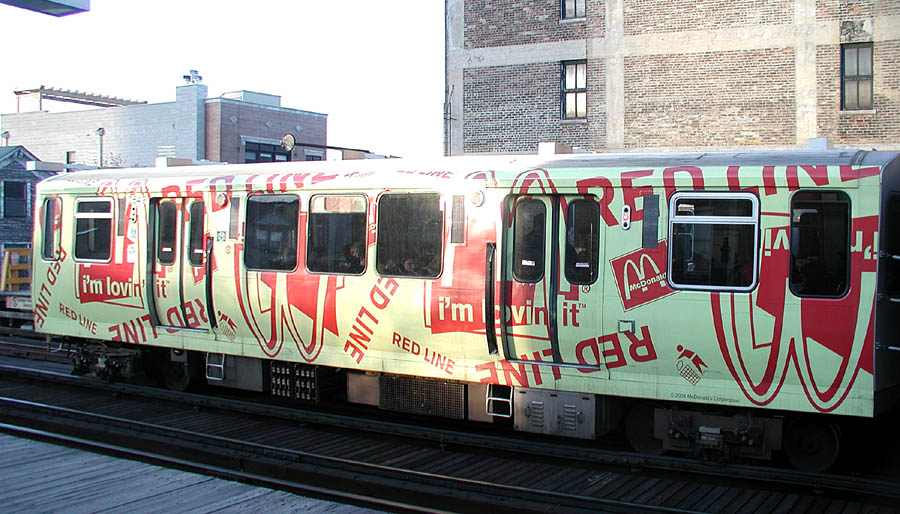
Corporate Transit Branding Raises Concerns About Neighborhood Identity


In light of my research on the link between mass transit identification design and neighborhood identity, I was immediately struck by the news coming out of Toronto last week that the TTC is contemplating selling station and subway line naming rights to the highest corporate bidder. This isn't the first time such proposals have been floated by cash-strapped transportation agencies, but if the possibility is to be taken seriously, we should consider its less tangible potential consequences for the communities it may effect.

My research has shown that the identification of transit lines and stations can be a highly sensitive issue in cities, and that these seemingly innocent naming and design decisions can potentially have an important impact on local identity (click for pdf). For instance, not only have drawn out debates demonstrated passionate differences in opinion about how a light rail line's name and color ought to reflect the character of the communities it serves (as has been the case in Los Angeles), but evidence suggests that choosing neighborhood- or landmark-based names for rail stations can to promote (as in Chicago) or even outright define (as in London) community identity, both locally and throughout the system.

So beyond the awesome mock-ups of some new Toronto station signage and a gorgeous system map that the folks at Torontoist created, there may be wider implications of corporate sponsorship on this scale, especially when it concerns things as tied to local culture and identity as transit stations. Would we sell naming rights to our city parks, branch libraries, post offices, or schools?


Of course, we cannot pretend such sponsorship doesn't provide serious financial benefits to cash-strapped localities. There are no doubt plenty of riders who would gladly change the name of their local station (maybe even the name of their neighborhood!) in exchange for better transit service. Subway systems are already rife with advertising, and transit agencies should, I think, take advantage of the eyeballs to help subsidize the system. (To that end, kudos to the TTC at least for considering ending their contract with CBS Outdoor and maybe taking a proactive stance on collecting these advertising dollars directly.) Though even here, Jordan Seiler of the Public Ad Campaign has some thoughts on the extremes at which excessive efforts to convert trains and stations into billboards can be too much.

It's a delicate tradeoff, but at the very least the debate about full-scale corporate branding of transit stations and lines should be informed by an awareness of its potential implications for neighborhood identity, and in turn the real importance of this identity for urban communities.

Feb 14, 2011

The Faux-Tuscan-ization of Downtown Los Angeles


The recent approval of Geoffrey H. Palmer's "Lorenzo" development, at 23rd and Flower just south of Downtown L.A., will see the the Italophile real-estate tycoon's empire of apartment complexes grow to a total of 9 in the area. With nearly identical cheesy aesthetics to match their Tuscan-inspired names, I got to wondering whether we were actually starting to hit a point where they make up a large enough proportion of new residential properties in and around the financial district that the Palmer aesthetic is a noticeable aesthetic for the whole area!

I threw this together in Google maps (click for link to interactive map):


Of course, there are far more Downtown residential properties of both the converted historic bank building variety (seen throughout the Historic Core) and the new-build-loft glass and steel variety (as has come to define the South Park neighborhood). But Palmer's properties are arguably doing something similar in the north and west periphery of the financial district - especially as viewed from the 110 Freeway! Add to this some other similarly-styled developments like the ultra-cheesy "City Lights" complex opposite the Convention Center and a number of new buildings near USC (including the so-identical-and-aptly-named-I-assumed-it-was-Palmer "Tuscana") and you really have a theme going.

I've long had a sort of love-hate relationship with Palmer's buildings, ever since the "Medici" went up with great fanfare around 2000-2002 while I was living nearby, and soon became resort-style home to a many of my fellow USC students. On the one hand, Palmer was arguably pretty important in promoting the residential resurgence in Downtown L.A. - which has on measure been a good thing for the city. And certainly relatively dense apartment buildings are better than the surface parking lots most of his projects have replaced. But Palmer has been a less than caring community member, long dragging his heals about including low-income units, and the buildings themselves are lousy neighbors for their immediate surroundings, the largely lower-income streets north and west of the financial district where they have been plopped down (see this 2004 Downtown News piece for more on Palmer's controversial past.) And regardless of how one feels about the luxurious grounds and interiors or the cheesy Italianate design, many are fortress-like at street level, closed in on themselves and primarily accessible through their underground parking garages.


Even Lorenzo, despite concessions to community demands made to win approval and explicit claims of a transit- and pedestrian-oriented design - all certainly good signs - may still be headed for disappointment in this regard. (See this thorough, if now somewhat outdated, Streetsblog LA dissection of the project's T.O.D. potential). At best I suppose we can hope for something not unlike USC's Tuscana, somewhat oriented toward the street, with (unfortunately bland corporate) commercial use below the apartments. Aesthetically, probably no hope. At least Tuscana matches the Italianate explosion that is the rest of USC's central campus. Another hanging garden-inspired tropical Tuscan paradise at Lorenzo on 23rd Street will really be odd.

Feb 12, 2011

DIY Urban Design at the L.A. Eco Village


Among the first instances of do-it-yourself urbanism that I became aware of a few years ago were the projects of the Los Angeles Eco Village, and learning about them was a big influence on my decision to pursue my research on these and similar activities in cities around the world.

I was fortunate to go back again this week to meet with Joe Linton and other residents of this cooperative living 'intentional community,' near Vermont and Beverly in central Los Angeles. Over the years they have reclaimed their intersection with street art (à la Mark Lakeman and Portland City Repair), painted their own crosswalks, and placed seating and trees in a beautiful bulb-out to calm traffic on the street. They've also been known to calm traffic a little more actively, by closing their street with street parties and family dinners. Here are some more recent pics:


Nov 13, 2010

A Tale of Two Main Streets...

The LA Times' Chris Reynolds has this neat photo essay (and story) comparing Disneyland's Main Street, USA to its "inspiration": that of Marceline, MO, where Walt grew up. (Although as one commenter helpfully points out, Disneyland's Main St. may owe more of its design to legendary imagineer Harper Goff and his hometown, Fort Collins.) Anyway it's an interesting contrast in comparative themes across very different socio-spatial realities.

Marceline is a classic Midwestern grid-plan railroad town. It has a (2000 census) population of about 2,500 - apparently the same as it was within a few months of being founded in 1888. It has a population density of 787 people per mile in its 3.3 square miles, surrounded by pastoral Linn County farmland. Disneyland, meanwhile, has an average daily attendance of around 40,000 (variable to date, day of the week, and weather). That gives it an average population density of 307,692 people per mile in its 83 public acres (0.13 square miles), surrounded by pastoral Orange County sprawl.

(these google images are at an identical scale; click to zoom)

From an earlier article on Marceline:
“Since the trains don’t stop here anymore, it’s kind of been a dying little town,” said Vicki Lodder, 57, a lifelong Marceline resident and owner of the recently opened Ma Vic’s Corner Cafe. “So many stores have closed. Marceline needs things on Main Street.”
The train stopped stopping in Walt's hometown years ago. But on the bright side, Disneyland had record-setting annual attendance in 2009.

In 2000, Marceline had a median household income of $25,000 (and a per capita income of $15k). It was 98.2% white, although the Times reports there is a Mexican restaurant. Meanwhile, Disneyland's demographic makeup is uncertain, if rather fascinatingly discussed here (fascinating in that most commenters claim not to notice anything about race while in there). We do know that the population of Toontown is, of course, about seven hundred million, a lemon, and screw.

See also my somewhat similar photo essay comparing the built environments of Detroit and Phoenix.

Aug 17, 2010

On "Fringe" Gentrification Processes in a Neighborhood in Transition

This is the abstract for the paper I gave yesterday at the American Sociological Association conference in Atlanta. I was part of a session on "Transformative Developments in 21st Century Cities and Suburbs" organized Charles Jaret. I was pleased with my presentation and all the questions and feedback I received, as well as the interesting talks from the other panelists, whose projects I think all resonated with each other.


The Edge of the Island: Neighborhood Identity and Evolving Communities in 'Liminal Places'

This paper examines the contemporary processes at work in urban areas without clear spatial identities that are simultaneously facing the challenges of cultural change and gentrification. I do so through the close analysis of one such ‘liminal place’ on Chicago’s West Side. I use the phrase ‘community on the edge of the island’ to describe the area, inspired by an interviewee who referred to the tenuous search for a sort of ideal bohemian hipness as the need to stay as “close to the edge of the island” as possible without actually leaving it. Making use of ethnographic and geographic field work in the area and a review of relevant literature, the study examines how neighborhood identity is imagined, projected and negotiated by different actors, and the role of socio-economic processes, institutions, and spatial histories and mythologies themselves in these processes. First, I discuss the idea of a place without a name and introduce the area that I call Edgetown. This is followed by a more detailed analysis of the transitional nature of the area, leading in turn to the core discussion of the communities – both long-established and newly forming – that are to be found there and the specific time and space that make the “the edge of the island” such a revealing subject for understanding current neighborhood change.

May 26, 2010

The Potential for 'Community Supportive' Transit

In a new article just published in the Journal of Urban Design, I present the findings of my research on the link between mass transit design and neighborhood identity. With a review of naming logics for several major transit systems, I argue that rail transit lines and stations are uniquely well-suited to the promotion of community identity through simple decisions about their identification and other basic design features.

By taking local identity into account, cities can not only foster a more transit-supportive community, but actually build more community-supportive transit. For cities like Los Angeles, trying to address recognized deficiencies in both mass transportation and community identity and cohesion, recognizing this connection could be crucial.

Here's the abstract for the article. It can be accessed here (or just email me for a copy).

Rail Transit Identification and Neighborhood Identity: Exploring the Potential for 'Community-Supportive Transit'

The preservation and promotion of neighbourhood identity is important in contemporary cities. Los Angeles, long known for its lack of both effective mass transit and, separately, local identity and cohesion among its neighbourhoods, is currently working to address each of these issues, yet little attention has been paid to the possibility that the two can be directly related. This paper investigates how rail transit line identification and station-naming decisions are not only important to community members but can have an impact on the neighbourhood identity. After introducing these ideas with the case of the identification of the Metro 'Expo Line' in LA, the paper turns to a comparison of naming logics for other local institutions and other major transit systems, arguing that cities could benefit from considering 'community supportive' transit design that promotes local identity in addition to more pragmatic wayfinding concerns.

Douglas, Gordon C. C. "Transit Identification and Neighborhood Identity: Exploring the Potential for 'Community-Supportive Transit,'" Journal of Urban Design, vol. 15, no. 2, May 2010. 175-193.