Jul 31, 2011

In Defense of L.A.'s Mojo


A week or so ago, a blog post by Joel Kotkin was making some waves among economic geographers, urban studies people, etc., for its rather alarming headline proclaiming that "America's Young and Restless Will Abandon the Cities for the Suburbs." While I didn't dispute the actual, less shocking, conclusions of the piece - 'suburbs' are increasingly important job centers and even people who were hip in their 20s may still leave urban cores to raise families in their 30s - like many people I was wary of the article's phrasing, the misinterpretation implied by the headline (that suddenly the hip, creative youth of America were more attracted to white picket fences than to diversity and loft-dwelling), and the ever-worrisome definitional problems surrounding 'suburbs versus city debates' (not just a problem of Professor Kotkin's, though he has been criticized on this count before). Still, I filed it away as an interesting counterpoint to the assumptions of creative class dogma and went on with my life.

But THEN, this weekend, a friend forwarded me Kotkin's latest, and this one struck a cord. The article, an op-ed piece for the Wall Street Journal entitled "How Los Angeles Lost its Mojo," promised another neo-traditionalist, pro-business critique of the too-urban, too-dense progressive urban policies that he views as the wrong fit for Western cities like L.A. Now, I too am a believer that the success of Los Angeles lies in its exceptionalism and dislike the idea that the city should try to copy New York in the form of things like "LA Live", but Kotkin and I are polar opposites when it comes to being fans of walkability, density, transit, etc., so I knew that I would have my differences with some of his policy proscriptions. What surprised me, however, was how openly Kotkin shows his ideological cards here (perhaps it was inspired by the friendly audience of the Journal's editorial pages).

Right up front, sounding for all the world like Harry Chandler, he praises the "pleasant climate and a business-dominated political economy" of the early 20th century -- which was one of the the most vicious and violently anti-union, anti-labor, anti-mexican, and pro-turning-L.A.-into-a-banana-republic periods in American history. He moves on to praise the "pro-business" Riordan/Wilson years, which he ties to L.A.'s economic successes of the late 1990s, before proceeding to smear current-Mayor Villaraigosa for the sorry corporate business climate and other economic troubles of today...

Jul 13, 2011

Touring Toronto with the Urban Repair Squad


I was up in Toronto last month for the Experience the Creative Economy conference at the UofT's Martin Prosperity Institute (see earlier post). While I was in town I had the honor and privilege of taking an impromptu guided tour of D.I.Y. urbanism in the city with a spokesperson for the acclaimed local bike lane champions and all-around unauthorized do-gooders The Urban Repair Squad.

Anti-bike signs on the TTC were replaced with a more bike-friendly message (above), and even some classic pieces, like these bike-lane commentaries and "pothole onomatopoeia" are a bit worn down but still doing their part.


As my URS liaison explained, "the group kind of fulfills an official function [...] Above all it asks questions about how urban design is used, and what it is used for."

We also saw some fantastic street art:

Above, Posterchild stencil and others. Below, a piece by Poser (is it?) in Kensington Market, and a slightly disregarded Banksy in an alley. (Click for larger images)

Jul 8, 2011

Slow Puncture - Shoreditch Street Art

Seems about time for another cool music video on a theme close to my heart (see previous entries in this vein here and here)... this a cool tune, great video, and lots of shots of London's lovely, hip Shoreditch neighborhood. Being one of the world's foremost street art meccas, the video features plenty of that:


For more on the artist, She Makes War, and the video and the song and all that, please visit:
http://www.shemakeswar.com/sp.htm

Thanks Oli.

Jun 5, 2011

DIY Urban Design and the Creative Economy

I'm honored to have been selected to participate in the Experience the Creative Economy conference at the University of Toronto's Martin Prosperity Institute, June 21st-23rd. I'll be speaking about my research on DIY urban design and what it may have to tell us about spatial rights and responsibilities in the so-called 'Creative City', and taking part in three days of collaborating and workshopping around issues pertaining to creativity and economic development. Here's the abstract for my paper:


Do-It-Yourself Urban Design
'Improving' the City Through Unauthorized, Creative Contributions

There are numerous ways in which people make illegal or unauthorized alterations to urban space, its uses, or meanings. This paper presents research into a particular type of unauthorized intervention: the creative, highly localized, and largely anonymous practices that are aimed explicitly at “improving” particular aspects of the built environment. In other words, informal “do-it-yourself” urban design contributions. In painting their own crosswalks and bicycle lanes, building and installing much-needed benches and other street furniture, or creating faux-official signage to promote needed civic improvements or commemorate unheralded events, people respond to perceived inadequacies in their communities and take design responsibilities into their own hands; even small-scale acts of aesthetic alteration, such as guerrilla gardening, billboard liberation, and yarn-bombing, assert a vision of the city as popular space open to creative, individual “beautification.” Building on twelve months of qualitative fieldwork and interviews with 40 individuals in six cities (London, Los Angeles, New York, Pittsburgh, Toronto, and Vancouver), I distinguish these practices from “traditional” forms of illegal spatial intervention and discuss their implications for understanding our relationship to the contemporary city. We do not normally think of the urban built environment as something we can reshape at our whim; its uses and meanings are normatively – and often legally – defined and regulated, essentially altered only by professionals. That an increasing number of individuals treat the built environment as open to personal reinterpretation raises a number of questions concerning rights, responsibilities and popular expectations as well as wider and perhaps unintended consequences.

May 3, 2011

DIY Urban Design Piece on GOOD.is

[Updated]

Happy to report that a brand new piece of mine is now up on GOOD! It's sort of a glorified slideshow of various instances of DIY urbanism (taken by both myself and others) and featuring short descriptions and quotes from my ongoing research. The piece is out just in time for the presentation I'm giving on this work at the annual meeting of the Assoc. of American Geographers.

Click the screenshot to visit the article on GOOD.is:

Please check it out!


UPDATE: I'm happy to say the piece has received a ton of great attention, including a nice summary on Planetizen that I'm particularly proud of, as well as other blogs and heaps of tweets from such esteemed urban design commentators as Allison Arieff and Richard Florida. Thanks everyone for taking a look!

May 2, 2011

The bin Laden Raid and Web Hyperinteractivity...

I realize not everyone is as impressed with or interested in the crazy extent to which social media and web interactivity now respond to breaking news like some sort of super dynamic and fast-moving biosystem, but this morning I've just been fascinated by a number of examples of it this as relating to the bin Laden raid. So, some musings:

First, this Pakistani guy (@ReallyVirtual) basically live-tweeted the entire raid as it happened, without knowing what it was, from somewhere nearby enough to hear it go down - and became an almost instantaneous celebrity. This is a compilation somebody made of his "coverage": http://chirpstory.com/li/1288 (or just check out his actual twitter feed: http://twitter.com/#!/ReallyVirtual ) After tweeting for like 16 hours straight (beginning at 1am his time!) and fielding sudden massive requests for interviews and such, his last tweet a few hours ago was "Bin Laden is dead. I didn't kill him. Please let me sleep now."

Apr 7, 2011

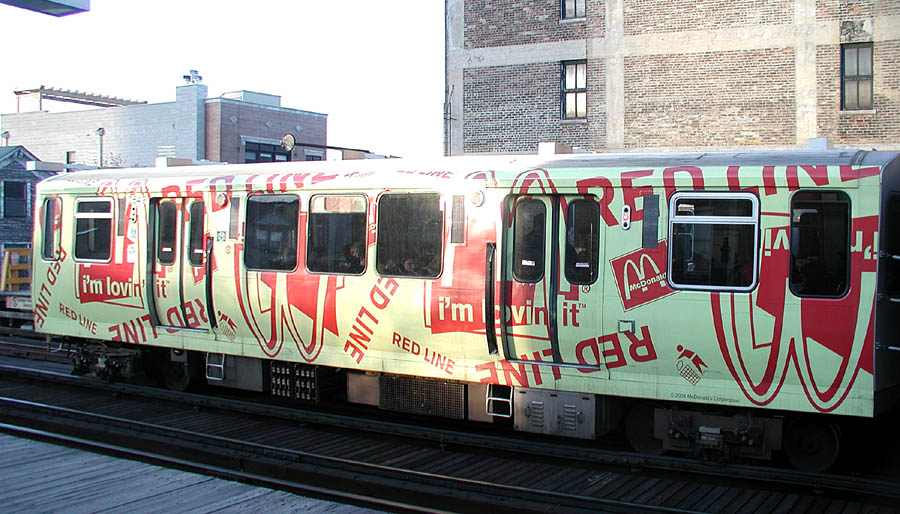
Corporate Transit Branding Raises Concerns About Neighborhood Identity


In light of my research on the link between mass transit identification design and neighborhood identity, I was immediately struck by the news coming out of Toronto last week that the TTC is contemplating selling station and subway line naming rights to the highest corporate bidder. This isn't the first time such proposals have been floated by cash-strapped transportation agencies, but if the possibility is to be taken seriously, we should consider its less tangible potential consequences for the communities it may effect.

My research has shown that the identification of transit lines and stations can be a highly sensitive issue in cities, and that these seemingly innocent naming and design decisions can potentially have an important impact on local identity (click for pdf). For instance, not only have drawn out debates demonstrated passionate differences in opinion about how a light rail line's name and color ought to reflect the character of the communities it serves (as has been the case in Los Angeles), but evidence suggests that choosing neighborhood- or landmark-based names for rail stations can to promote (as in Chicago) or even outright define (as in London) community identity, both locally and throughout the system.

So beyond the awesome mock-ups of some new Toronto station signage and a gorgeous system map that the folks at Torontoist created, there may be wider implications of corporate sponsorship on this scale, especially when it concerns things as tied to local culture and identity as transit stations. Would we sell naming rights to our city parks, branch libraries, post offices, or schools?


Of course, we cannot pretend such sponsorship doesn't provide serious financial benefits to cash-strapped localities. There are no doubt plenty of riders who would gladly change the name of their local station (maybe even the name of their neighborhood!) in exchange for better transit service. Subway systems are already rife with advertising, and transit agencies should, I think, take advantage of the eyeballs to help subsidize the system. (To that end, kudos to the TTC at least for considering ending their contract with CBS Outdoor and maybe taking a proactive stance on collecting these advertising dollars directly.) Though even here, Jordan Seiler of the Public Ad Campaign has some thoughts on the extremes at which excessive efforts to convert trains and stations into billboards can be too much.

It's a delicate tradeoff, but at the very least the debate about full-scale corporate branding of transit stations and lines should be informed by an awareness of its potential implications for neighborhood identity, and in turn the real importance of this identity for urban communities.

Mar 5, 2011

"DIY Urban Design" Headed to ASA

A paper presenting the results of my dissertation research pilot study has been accepted for presentation at the American Sociological Association's annual conference in Las Vegas this August. I'll be in the regular session on Popular Culture, organized by Dr. Terry McDonnell. This is an abstract for the paper.


Do-It-Yourself Urban Design

Making Local Improvements Through Unauthorized Alterations of Urban Space

All manner of unauthorized alterations and occupations of the built environment can be seen in the city, from juvenile bathroom graffiti to organized political demonstrations. Indeed, practices like graffiti and street art, guerrilla gardening, and the unauthorized use of particular spaces for unconventional purposes have become relatively common features of urban life in recent decades. Limited existing social science research on these alterations (which I collect for shorthand as "spatial interventions") tends to group these practices into one of two basic categories: as strategies of radical political protest and even "resistance," or as little more than concept art, self-promotion, juvenile acting out, or criminal vandalism. Yet in new research I have found many cases that do not fit comfortably with either perspective. These practices are better described (and thus distinguished) by a third logic: intentional but small-scale, ground up, creative "improvements" to particular spaces. This paper briefly reviews the existing literature to draw out its core assumptions, and then presents the findings from a six month study of spatial intervention practices in New York, Los Angeles, and London that suggests an alternative understanding of unauthorized alterations as D.I.Y. urban design contributions.

Feb 14, 2011

The Faux-Tuscan-ization of Downtown Los Angeles


The recent approval of Geoffrey H. Palmer's "Lorenzo" development, at 23rd and Flower just south of Downtown L.A., will see the the Italophile real-estate tycoon's empire of apartment complexes grow to a total of 9 in the area. With nearly identical cheesy aesthetics to match their Tuscan-inspired names, I got to wondering whether we were actually starting to hit a point where they make up a large enough proportion of new residential properties in and around the financial district that the Palmer aesthetic is a noticeable aesthetic for the whole area!

I threw this together in Google maps (click for link to interactive map):


Of course, there are far more Downtown residential properties of both the converted historic bank building variety (seen throughout the Historic Core) and the new-build-loft glass and steel variety (as has come to define the South Park neighborhood). But Palmer's properties are arguably doing something similar in the north and west periphery of the financial district - especially as viewed from the 110 Freeway! Add to this some other similarly-styled developments like the ultra-cheesy "City Lights" complex opposite the Convention Center and a number of new buildings near USC (including the so-identical-and-aptly-named-I-assumed-it-was-Palmer "Tuscana") and you really have a theme going.

I've long had a sort of love-hate relationship with Palmer's buildings, ever since the "Medici" went up with great fanfare around 2000-2002 while I was living nearby, and soon became resort-style home to a many of my fellow USC students. On the one hand, Palmer was arguably pretty important in promoting the residential resurgence in Downtown L.A. - which has on measure been a good thing for the city. And certainly relatively dense apartment buildings are better than the surface parking lots most of his projects have replaced. But Palmer has been a less than caring community member, long dragging his heals about including low-income units, and the buildings themselves are lousy neighbors for their immediate surroundings, the largely lower-income streets north and west of the financial district where they have been plopped down (see this 2004 Downtown News piece for more on Palmer's controversial past.) And regardless of how one feels about the luxurious grounds and interiors or the cheesy Italianate design, many are fortress-like at street level, closed in on themselves and primarily accessible through their underground parking garages.


Even Lorenzo, despite concessions to community demands made to win approval and explicit claims of a transit- and pedestrian-oriented design - all certainly good signs - may still be headed for disappointment in this regard. (See this thorough, if now somewhat outdated, Streetsblog LA dissection of the project's T.O.D. potential). At best I suppose we can hope for something not unlike USC's Tuscana, somewhat oriented toward the street, with (unfortunately bland corporate) commercial use below the apartments. Aesthetically, probably no hope. At least Tuscana matches the Italianate explosion that is the rest of USC's central campus. Another hanging garden-inspired tropical Tuscan paradise at Lorenzo on 23rd Street will really be odd.

Feb 12, 2011

DIY Urban Design at the L.A. Eco Village


Among the first instances of do-it-yourself urbanism that I became aware of a few years ago were the projects of the Los Angeles Eco Village, and learning about them was a big influence on my decision to pursue my research on these and similar activities in cities around the world.

I was fortunate to go back again this week to meet with Joe Linton and other residents of this cooperative living 'intentional community,' near Vermont and Beverly in central Los Angeles. Over the years they have reclaimed their intersection with street art (à la Mark Lakeman and Portland City Repair), painted their own crosswalks, and placed seating and trees in a beautiful bulb-out to calm traffic on the street. They've also been known to calm traffic a little more actively, by closing their street with street parties and family dinners. Here are some more recent pics: